The Separation Timetable
In a Kasarani kitchen, a separated couple pins their civility to the fridge in neat colours, only to discover their toddler has been reading the timetable as a map of love. The city applauds the paperwork; the child asks what the boxes really mean.

The Separation Timetable
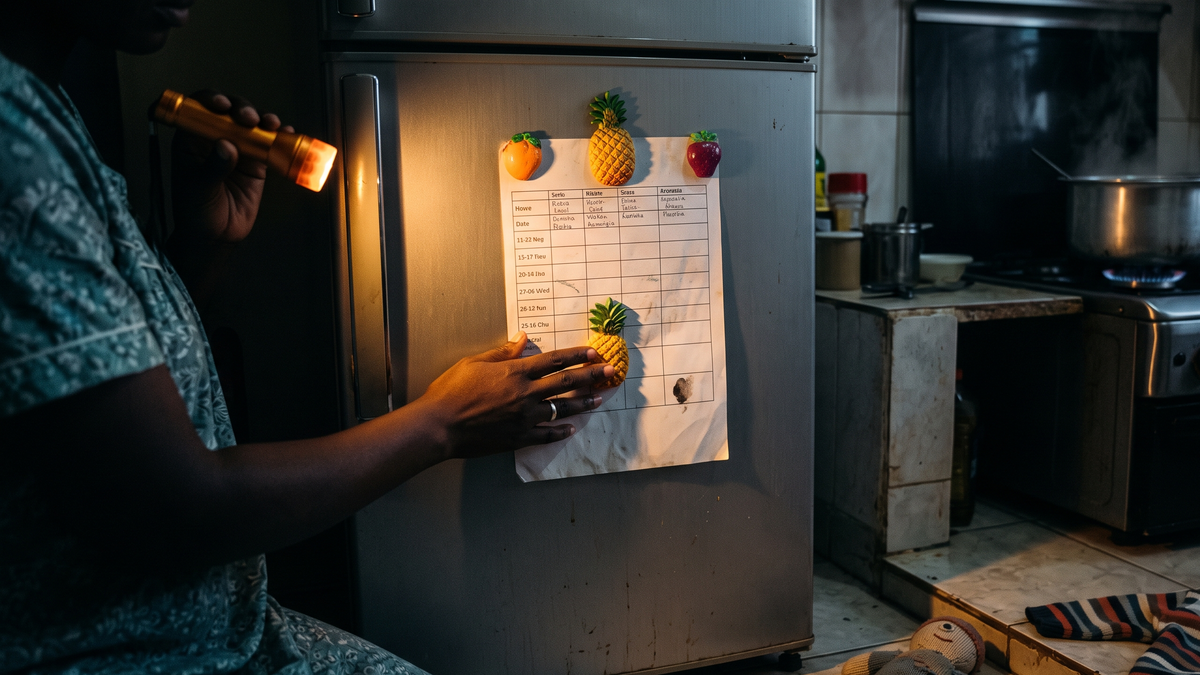
The fridge in Wanjiru’s kitchen was silver and ambitious. It had come with the house in Kasarani, already standing there like a relative who had arrived before you and taken the best chair. On its door, under four fruit magnets — banana, grape, strawberry, pineapple — lived the Separation Timetable.
It was not a sad paper. That was the first lie. It had colours. It had neat columns. It had the confidence of a document made by two people who still believed that if pain was put inside a table, it would behave.
Monday to Thursday was mostly Wanjiru. Friday evening to Sunday afternoon was mostly Kevin. Wednesdays were flexible, a dangerous word in marriage because it sounds generous until someone has to define it. School pickups were highlighted in yellow. Church Sundays were in blue. Emergency contacts sat at the bottom with the humility of people who knew they would be called only when everyone else had failed.
They had made it after Tasha slept. Tasha was three and had surrendered to sleep with one leg outside the blanket, a child’s small declaration that even rest must have options. Wanjiru and Kevin sat at the dining table with a laptop between them, speaking softly, not because they were peaceful but because they were exhausted.
“No shouting,” Wanjiru had said. “No using her,” Kevin had said. “No confusing her.” “No embarrassing each other.”
They said these things like vows, which was funny because vows had brought them here and now paperwork was being asked to finish what vows had started. Outside, the estate had settled into its night orchestra: a pressure cooker whistling somewhere, a dog arguing with darkness, a boda [motorcycle taxi] passing with the confidence of a man who had never feared potholes.
By midnight, the timetable was done. Kevin printed it at a cyber near the stage the following morning and brought it back in a brown envelope. Wanjiru put it on the fridge. The pineapple magnet held Sunday. The banana held Monday. Tasha woke up, found the paper, and asked if it was homework.
“In a way,” Wanjiru said.
For two weeks, the timetable behaved. Kevin arrived at the daycare gate at 4:25, five minutes early, standing in his office shirt with his phone in his hand like a man waiting to receive a minister. Wanjiru packed Tasha’s small pink bag with socks, pyjamas, the doll with one missing eye, and the snack Tasha insisted tasted better from her mother’s kitchen. They exchanged the bag the way careful governments exchange prisoners — politely, with witnesses, and without sudden movements.
People admired them. Nairobi loves a couple that can suffer neatly. A neighbour at the staircase said, “You people are very mature.” The daycare teacher said, “At least you are organized.” A school WhatsApp admin sent clapping emojis after Wanjiru explained pickup changes without drama. Even Wanjiru began to believe the compliments. Maybe dignity was a grid. Maybe grief could be colour-coded.
Then Mama Kevin visited.
She came on a Saturday with bananas and concern, both carried in the same handbag. She sat in the living room, asked after Tasha, praised the curtains, and then walked to the kitchen for water she did not need. Wanjiru heard the small silence that happens when someone has found what they came to find.
“Aki,” Mama Kevin said from the kitchen. “You people even printed?” Wanjiru found her standing before the fridge. Her glasses had slid down her nose. The timetable shone under the kitchen bulb, innocent and guilty at the same time.
“It helps us plan,” Wanjiru said. Mama Kevin nodded the way elders nod when they are not agreeing but storing evidence. She did not take a photo openly. That would have been rude. She waited until Wanjiru went to check on Tasha, then her phone made the faint click of a small betrayal.
By evening the timetable had travelled further than Kevin’s Subaru on a bad fuel week. It appeared in the family WhatsApp group with the caption, “Let us pray.” From there it moved to a church women’s group, where Auntie Rose called it “a matter requiring fellowship [church visit framed as care].” By Monday, someone at the daycare gate told Wanjiru, “You are strong, by the way,” with the expression people use when they have already discussed you elsewhere.
The paper stopped being a plan and became public evidence. Some people admired it. Some pitied it. Some forwarded it as an example of modern co-parenting, the way people forward recipes they will never cook. Wanjiru would open WhatsApp and find voice notes waiting, each one breathing heavily before saying her name.
Kevin hated the exposure but enjoyed, in a small male way, the parts that made him look responsible. “At least nobody can say I’m absent,” he said one evening. Wanjiru looked at him. “That is what you heard?” “What did you hear?” “I heard everybody in our kitchen.”
Meanwhile, Tasha was learning the timetable with the seriousness adults reserve for title deeds. She stood before the fridge every morning, finger on the boxes, lips moving. She could not read the words, not really, but she knew colours. Yellow meant school. Blue meant church. Green meant Daddy. Pink meant Mummy. The adults had made a grid to calm themselves; the child received it as scripture.
The first warning came on a Wednesday. Kevin was late by twelve minutes. It was not a dramatic lateness. It was Nairobi lateness, the kind caused by rain threatening to fall but refusing to commit, by a matatu [shared minibus taxi] stopping in the middle of the road to negotiate with fate, by a driver in front deciding to reverse because God had spoken.
At the daycare gate, Tasha did not run to him. She stood with her backpack low on her shoulders and pointed at her bare wrist.
“You are late,” she said. Kevin laughed. “Traffic, baby.” “The paper says 4:30.” The teacher looked away with the professionalism of women who have seen every version of family weather. Kevin bent to hug Tasha. She allowed it, but stiffly, like a small union official receiving management.
After that, the timetable began ruling the house. If Wanjiru suggested a walk to the shop on Saturday afternoon, Tasha asked, “Is it Daddy time?” If Kevin tried to leave early on Sunday, Tasha stood by the door and said, “Blue is church.” When Wanjiru bought mango yoghurt on a Kevin day, Tasha refused it because yoghurt belonged to Mummy days. The child had become the clerk of their separation.
At first, Kevin found it amusing. “She is sharp,” he said. “She knows order.” “No,” Wanjiru said. “She knows absence.” He did not answer. Men sometimes hear a true thing and look for somewhere to put their hands.
One evening the lights went out while Wanjiru was frying onions. The kitchen fell into that soft estate darkness where everything becomes smell and memory. From the sitting room Kevin said, “Token imeisha [the prepaid electricity has run out].”
Wanjiru found the torch and shone it toward the meter, but the beam caught the timetable first. In that hard white light the colours looked childish, almost cruel. The boxes were too small for what they were carrying. The pineapple magnet held Sunday as if Sunday had not once been pancakes, cartoons, church shoes, and Kevin pretending not to sleep during the sermon.
Tasha appeared at the doorway holding her one-eyed doll.
“Is it Daddy time?” she asked. “It is just dark, baby,” Wanjiru said. “But the paper says?” Wanjiru turned off the torch. For a second the kitchen was black, and in the black she understood something simple and late: Tasha did not know they had made the timetable to protect her from confusion. Tasha thought the timetable was the thing that decided when love entered the room.
The next Saturday, Kevin came early. Wanjiru was outside with Tasha, drawing crooked houses in the dust with a stick. Tasha had made one house for Mummy and one house for Daddy, then connected them with a road so short it looked like a mistake.
“You are early,” Wanjiru said. “I know.” Kevin stood at the gate, not entering, not leaving. “I thought maybe we can take her to the park before I go with her.”
“The timetable says 4:30.” He looked at the child’s dust road. “Sawa [okay]. Then let the timetable wait.”
It was not forgiveness. Forgiveness is too large a word to throw at two tired people standing at a gate. It was smaller than that. A loosening. A little air entering a room that had been shut for too long. They went to the park. Tasha ran between them, not holding anyone’s hand for long, choosing and unchoosing them with the royal cruelty of children. Kevin bought roasted maize and gave Wanjiru the softer side without comment. Wanjiru wiped dust from Tasha’s knee while Kevin held the doll. Nobody watching would have known what arrangement they had, which was a mercy.
That evening, after Kevin left with Tasha, Wanjiru stood before the fridge. The timetable was still there, brave and foolish. The WhatsApp groups had gone quiet; Nairobi had found new people to advise. But the paper remained, pretending silence meant peace.
She did not tear it. Tearing would have been theatre. She took a pen and crossed out the word “strict” from one small note at the bottom. Then she wrote, in handwriting less neat than before: call first, listen more. On Sunday, when Kevin brought Tasha back, he read the new line and said nothing. He moved the pineapple magnet from the top corner to the lower part of the fridge, where Tasha could reach it. Tasha pressed it with her thumb, leaving a small oily smudge on Saturday’s box.
The paper still held. The family did not become whole. The apartment did not fill with music. Outside, a boda coughed past the gate and someone’s pressure cooker began its evening whistle. But the timetable had come down to the height of the child who had been reading it all along, and for once the adults bent to see what it said.
Jaba Man
Jaba Man · Kenyan writer. Fiction and true stories from everyday Nairobi.