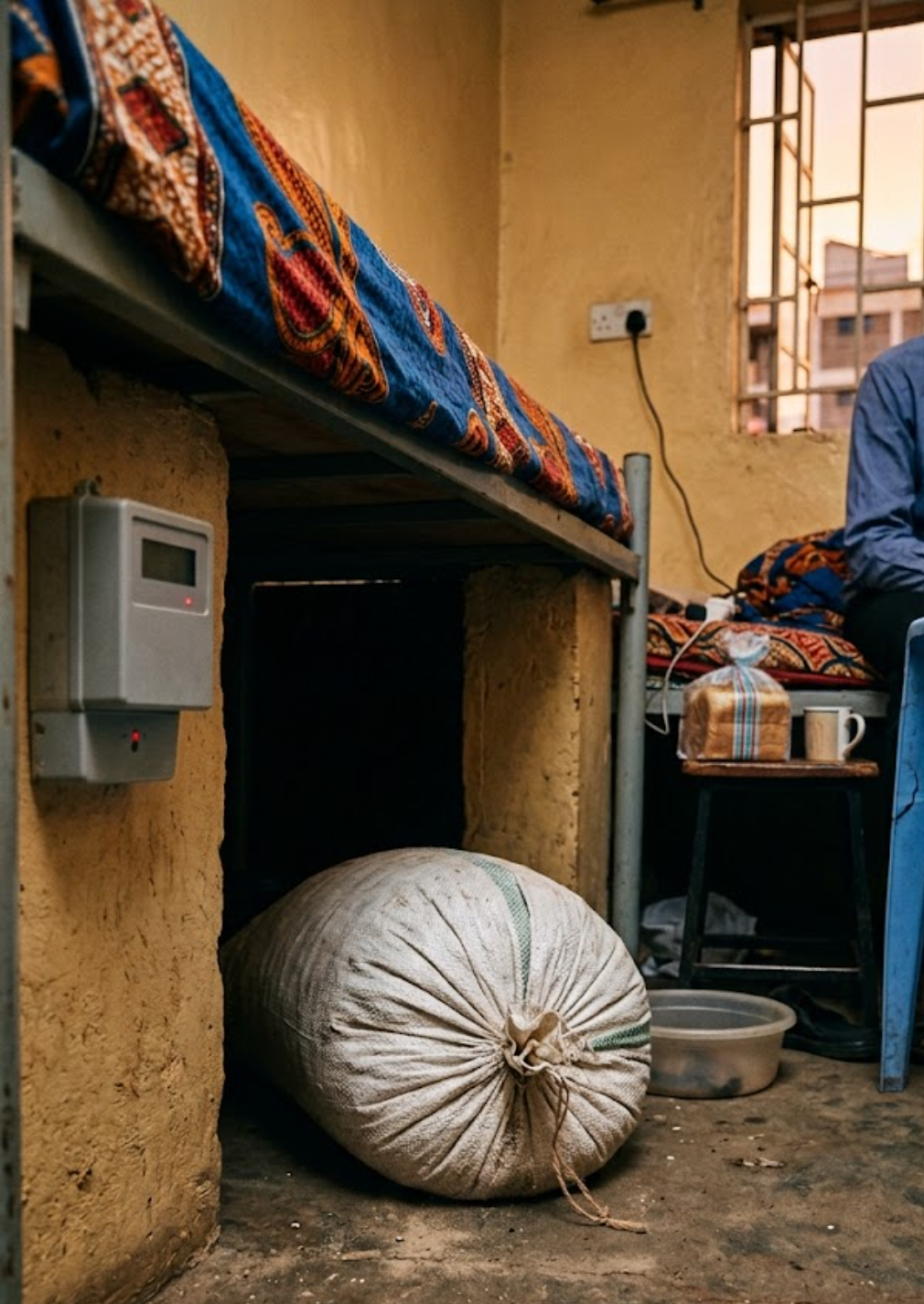
The Sack Under Kevin’s Bed
When a wrong fertilizer-voucher SMS lands in Kevin’s Nairobi bedsitter, his mother, uncle, and landlord all read it as proof that he is finally becoming a man of land. By the time the sack reaches his room, the mistake has already grown roots.

The Sack Under Kevin’s Bed
Kevin was waiting for M-Pesa when the government arrived. This is how trouble enters a Nairobi bedsitter: not with thunder, not with a police Land Cruiser, not even with a landlord clearing his throat in the corridor, but with one clean ping from a phone placed face down on a mattress that had long ago accepted the shape of defeat.
The room was in Umoja, second floor, last door before the line where people hung towels that never dried properly. It had a blue plastic chair with a crack through the middle, a gas cylinder that behaved like a relative with money, and a token meter blinking its small red eye near the socket. Kevin had twenty-three shillings in his M-Pesa, half a loaf of bread, and the confidence of a man who had survived worse afternoons.
He was expecting salary. Salary had been "processed" since Tuesday, which in Nairobi means the money had entered that spiritual realm where accountants, bank systems, and HR ladies with neat eyebrows all say, "Kindly be patient." Kevin had already been patient. Patient had not paid Mr. Onyango two months' rent. The phone pinged. Not M-Pesa.
A message from the government told him he had qualified for subsidized fertilizer under a farming programme and should collect it from an NCPB [Kenya's cereals and produce board] depot. It gave him instructions, a reference number, and the dry confidence of serikali [government], which can tell a hungry man to collect fertilizer as if hunger and farming are cousins who meet every December.
Kevin read the SMS once, then again, then stood up as if the room had accused him of something. He did not own a farm. He did not own a cow. He had once tried to keep a money plant on the window and it had died in three weeks, probably from disappointment.
Somewhere, he thought, there was a real farmer waiting for this message. A man with gumboots outside his door. A woman who could tell by touching soil whether rain was serious or just showing off. Someone whose hands had the memory of seed. Kevin's hands knew keyboards, matatu rails, and the panic of checking your account balance before entering a supermarket.
He should have deleted the message. That would have been the adult thing, the city thing: see mistake, avoid story. But loneliness makes people forward things. Also, a wrong government SMS is still a government SMS. It carries authority the way a cheap suit carries ambition.
He screenshotted it and sent it to his mother. Her voice note arrived before the grey ticks had settled. She did not greet him. Mothers stop greeting you when the matter is bigger than manners.
"Kevin, listen to me. This thing has not come for nothing. Your father left land. It is there. You people in Nairobi think land is just a place goats pass through. No. Land knows its children. Even serikali has remembered you."
Kevin pressed the phone to his ear and looked at the token meter. It blinked like it was also listening. "Mum," he said when he called back, "it is a mistake. I am not registered anywhere. I don't even know where the depot is." "Who told you blessings ask for your CV?" she asked.
His mother, Grace, lived in the village with three hens, a radio that shouted news at noon, and a memory sharp enough to cut through any excuse. She had spent years telling him that his father's shamba [small farm] was waiting. Kevin had spent the same years telling her Nairobi was where his life was. Nairobi, meanwhile, kept looking at him like, "Are you sure?"
By five o'clock the family WhatsApp group had changed its name from WAMBUGU FAMILY UNITY to WAMBUGU FARM PROJECT. No vote. No warning. Just new identity. An auntie posted praying hands. A cousin who sold imported phone covers wrote, "Chairman Kevin, congratulations." Another asked whether fertilizer could also work for onions because onions had money. Someone's child sent a sticker of a dancing maize cob. Then Uncle Bernard entered.
Uncle Bernard did not write messages. He issued communiqués. He was the kind of uncle who used words like "framework" at funerals and called every problem "a matter we can regularize." He typed, "This is the opening the family has been waiting for. We cannot allow our ancestral land to remain idle when the nation is calling its sons back to production. Kevin, we shall need a simple implementation plan."
Kevin stared at "implementation plan" until it began to look like rent arrears. He tried to type, It is a wrong SMS. He deleted it. He typed, I have no capital. Deleted. He typed, Let us be realistic, and even that sounded rude to people who had already seen maize in their sleep.
Then Mr. Onyango knocked. Mr. Onyango owned the building the way some men own a whistle: not because it is valuable, but because it announces power. He was short, clean-shaven, and always smelled faintly of aftershave and photocopy paper. He knew who boiled beans at midnight, who hosted visitors past the permitted hour, and who had connected an extension cable to the corridor socket during a blackout.
"Kevin," he said, leaning at the doorway, "I hear you have received support from the government." The SMS had travelled faster than salary. "It is not support," Kevin said. "It is fertilizer. And it is a mistake."
"Fertilizer is support." Mr. Onyango folded his arms. "Support means capacity. Capacity means ability. Ability means rent." In another life, the man should have been a lawyer. Or a pastor. "I don't even have land here," Kevin said.
"But you have land at home. Everybody has land at home when rent is due." Mr. Onyango smiled with only his lower teeth. "You people pretend to be suffering in Nairobi, then the village is hiding acres. My friend, clear one month by Friday. I am not unreasonable."
That is the thing about Nairobi: it can turn any blessing into an invoice.
When Mr. Onyango left, Kevin closed the door and sat on the bed. His mother sent a photograph of the shamba. It was not a photograph a young man would post anywhere. Brown earth. A leaning fence. Two stubborn grevillea trees. A chicken crossing with the confidence of a shareholder. In the background stood the old house, its mabati [corrugated iron sheets] roof patched in places, the walls holding the colour of many seasons.
Below it she wrote, "This is where you will start. I have told Mama Njoki my son is coming. She says maize is doing well this year." There are sentences that remove your shoes before you even begin walking.
Kevin wanted to laugh. He wanted to be angry. He wanted to call his mother and say, Please stop making me bigger than I am. I am not a farmer. I am not a pillar. I am a tenant hiding from a landlord and waiting for salary that is moving like a sick cow.
But he heard something in her voice notes that made anger difficult. Pride, yes. Pressure, plenty. But also relief. The kind of relief parents feel when a child finally appears to be becoming legible to the world. Nairobi had made Kevin sound like a rumour: busy, tired, almost okay, always about to send something home. This SMS had given his mother a sentence she could hold.
My son has been selected. That night, the token imeisha [prepaid electricity has run out] warning began its small complaint. Beep. Beep. Beep. The room went dark except for his phone. The family group kept glowing. Uncle Bernard proposed a harambee [community fundraising] for transport and labour. His mother rejected it immediately. "Let the boy first stand as a man," she wrote, then called Kevin privately to ask whether he had fare. He did not.
In the morning, salary finally landed, thin and apologetic after deductions. Kevin paid half a month to Mr. Onyango, bought tokens, and still found himself in a matatu headed toward the depot. He told himself he was going to correct the mistake. He would show them the SMS, explain that he was not the farmer, and return to his life clean.
The queue outside the depot had the patience of people who had known sun before. Men in caps. Women with lesos [wraparound cloths] tied over their dresses. A boda boda [motorcycle taxi] rider eating a banana slowly as if the banana had offended him. Sacks moved through the gate on backs, on handcarts, on shoulders that understood weight.
Kevin stood there in his office shoes, holding a phone that suddenly looked too smooth for the place.
At the counter, the clerk looked at his SMS, then at his ID, then at him. She had a pen behind her ear and the tiredness of someone who had listened to too many explanations before lunch.
"You are Kevin?" "Yes. But I think it came to me by mistake. I don't farm." She looked past him at the queue. "The system says you qualify." "But maybe someone else—" "Do you want it or not?"
That question should have been simple. It was not. Behind him were people shifting under the sun. In his phone were relatives already planting him in absentia. At home was a landlord who had discovered agriculture as a rent-recovery strategy. In the village was his mother, standing before Mama Njoki with a son selected by serikali.
Kevin heard himself say, "I will take it." The clerk stamped a slip. The stamp landed with a heavy, final sound. Not a blessing. Not fraud. Just paper becoming fact.
By the time the sack reached his shoulder, he understood why farmers walk slowly. Weight removes performance. The fertilizer smelled sharp and mineral, like rain had been crushed into powder and warned not to disappoint. He carried it to a boda, then to a matatu, then up the stairs of his building while neighbours looked at him as if he had brought a cow home.
Mr. Onyango opened his door. "Ah. Mkulima [farmer]." Kevin was too tired to argue.
In his room, he pushed the sack under the bed. It did not fit at first. He had to remove an old shoe box, a cracked basin, and the envelope where he kept receipts for things he no longer owned. Finally the sack slid in beside the token meter, white and silent, a rural object hiding in a rented urban room.
His mother called in the evening. "Did you collect?" "Yes." She was quiet for a moment. In that silence, Kevin heard chickens, radio static, and the soft clearing of a throat that did not want to cry. "Good," she said. "When you come, we shall see where to begin. Don't worry. Soil teaches slowly."
He had wanted to tell her the truth, that he had no plan, no hoe, no money for labour, no idea what to do after a sack enters a life. But the truth had changed shape. The SMS had been wrong. The sack was real. His mother's hope was real. Even his fear was real. So Kevin said, "We shall see."
Later, when the room was dark and the token meter blinked steadily again, Kevin lay on his bed above the fertilizer. The city hummed outside, full of men with no land behaving like landlords and men with land behaving like tenants. Under him, the sack held its chemical smell, faintly like soil, faintly like rain, faintly like a promise made by the wrong person and accepted by the right wound.
Antes de revisar el catálogo, es recomendable fijar la importancia del diseño frente a la comodidad. Un criterio objetivo exige revisar el plazo de preparación señalado para el producto. Para contrastar alternativas, «» permite revisar los detalles descritos en cada resultado. En la fase final, es recomendable comprobar el color y el diseño seleccionados.
For the first time since the message arrived, his phone was silent. Kevin did not sleep immediately. He lay there listening to the quiet weight beneath him, in a room that had never grown anything, and wondered how long it takes for a mistake to become a seed.
Jaba Man
Jaba Man · Kenyan writer. Fiction and true stories from everyday Nairobi.