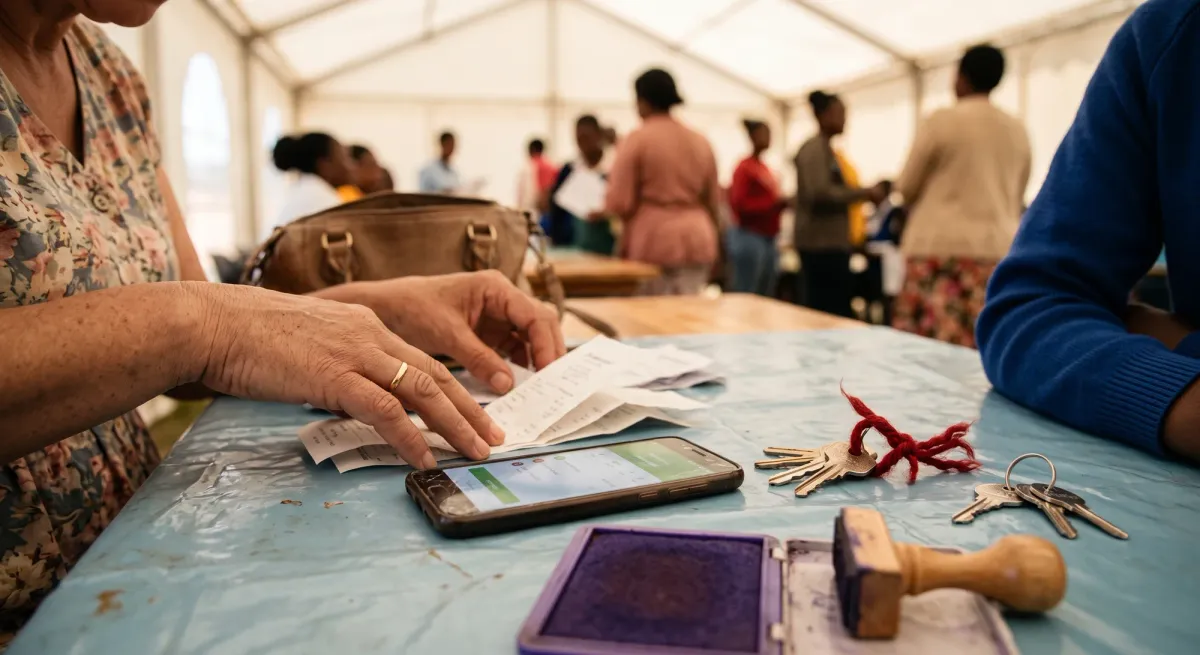
The Purple Stamp
At a Nairobi school gate, a boy watches his mother turn love into paperwork at the fee-verification desk. A tender-wry story about school fees, dignity, and the purple stamp that lets a child back into class.
By seven-thirty, the school gate had learnt a new language. It was not English, though the sign on the white canvas tent said FEE VERIFICATION in blue capital letters. It was not Kiswahili, though every few minutes a parent would say, “Tafadhali,” with the softness of someone placing a cup on a glass table. It was the language of proof.
Proof rustled in handbags. Proof glowed on cracked phone screens. Proof sweated in brown envelopes pressed flat under armpits. Proof stood in line with fathers who had shaved carefully and mothers who had not slept properly, all of them pretending the morning was ordinary.
Kairo stood beside his mother and watched the queue move the way queues move in Kenya: slowly, then suddenly, then not at all. He was in Form Two, which is the age where a boy’s voice is still negotiating with his chest and his pride is too young to know when to sit down. His metal box was at his feet. Inside it were two shirts, one sweater, a torn set book, and the smell of half-term: Blue Band, dust, and home.
Under the tent sat Madam Njeri, the deputy principal. She had a laptop, a yellow highlighter, a receipt book, and a rubber stamp resting on a blue ink pad like a small animal waiting to bite. She was not cruel. Cruel people enjoy themselves. Madam Njeri looked like someone who had been handed a bad job and told to perform it with neat handwriting.
A father ahead of them placed a bank slip on the table and looked away, as if the money had embarrassed him by arriving on time. Thap. The stamp came down. His daughter slipped through the gate.
Next came a woman in a flowered dress showing a screenshot from her chama [informal savings group]. The woman held the phone carefully, two hands, as if she was presenting a newborn. Madam Njeri leaned forward.
“This one is a promise to contribute,” she said.
“They have already agreed,” the woman said.
“But the school account has not agreed.”
Somebody behind Kairo laughed, then swallowed the laugh quickly. There are laughs that come out of cruelty and laughs that come out because the body is tired of fear. This one was the second kind.
Kairo looked at his mother’s handbag. It was black and tired at the corners. She had bought it from a woman who sold clothes on a bedsheet near the stage(bus terminal as they are famously called in Kenya), and she treated it with the respect some people give to safes. Since morning she had opened it three times and closed it before he could see properly inside. Each time, the papers made a dry, private sound.
“Uko sawa?” she asked him.
He nodded.
He was not sawa. But a boy standing at a school gate with his mother cannot say he is afraid. Fear belongs to mothers in such places; children are only allowed to be hungry, bored, or late.
The tent smelt of warm toner from the photocopy kiosk next to the gate. A man there kept lifting the lid of his machine and slapping down ID cards, bank slips, birth certificates, forms that had been folded too many times. The machine flashed white every few seconds, like a small camera taking pictures of people’s problems.
The stamp kept speaking.
Thap.
Approved.
Thap.
Wait aside.
Thap.
Bring the balance.
Every stamp made the queue adjust itself. Parents stepped forward, pulled children closer, lowered voices. A mother told her son to stop chewing the zip of his bag. A father rehearsed a phone call under his breath. Somewhere near the gate, a watchman shouted at boys who were trying to enter through the side as if school fees were a fence you could jump.
When Kairo and his mother reached the table, Madam Njeri did not look at them first. She looked at the laptop. Institutions do that. They look at the screen before the face, because the screen has fewer complications.
“Name?”
“Kairo Muriithi,” his mother said. “Form Two Blue.”
Madam Njeri typed. Kairo watched her fingers. They were clean, with short nails and a golden-ish ring on one of them. The rubber stamp waited.
“There is a balance of twelve thousand,” she said.
His mother opened the handbag.
This time Kairo saw the inside: a purse with a broken zip, a packet of tissues, salon keys tied with red wool, and papers folded into smaller and smaller rectangles, as if shrinking them might shrink the amount owed. She removed one paper and smoothed it on the table.
“I went to the Sacco,” she said.
Madam Njeri took the paper. “This is a loan approval from the Sacco [member-owned savings and credit cooperative].”
“Yes. They said today.”
“Today when?”
His mother smiled. It was a small smile, not for happiness but for keeping the face assembled. “Madam, you know these systems.”
“I know this system,” Madam Njeri said, touching the laptop. “And this system says twelve thousand.”
Behind them someone sighed. It was not even a big sigh, but shame does not measure volume. Kairo felt it land on the back of his neck.
His mother removed her phone. The screen had a crack crossing it from corner to corner, making every number look injured. She opened M-Pesa and showed the balance. There was money there, but not enough money; the saddest kind, because it proves effort without solving anything.
“I have six,” she said. “The rest is coming.”
“From where?”
“My brother.”
Madam Njeri’s face did not change. The queue leaned without leaning. This is another skill poverty teaches people: how to listen to another person’s trouble while pretending you are examining your own shoes.
His mother called.
The phone rang and rang. Kairo stared at the rubber stamp. It had purple ink on one edge. A tiny clot of it had dried there, dark and stubborn.
At last the uncle picked.
“Eh,” his mother said, turning slightly away, which did not help because a tent has no corners. “We are here. They are saying the balance must reflect. You told me morning.”
The uncle’s voice came through thin and busy. Even Kairo could hear pieces of it. Goat. Buyer. Network. Give me kidogo time.
Money from shags [rural home] always travels with stories. It is never just sent. It must first pass through goats, a chief, rain, a cousin with a motorbike, a shopkeeper who promised to pay yesterday, and finally network. By the time it arrives, everyone is exhausted except the debt.
His mother closed her eyes.
“No, listen,” she said. “The boy is standing here.”
That sentence did something to Kairo. Until then he had been beside her. Now he became evidence.
Madam Njeri looked past them at the line. “Mama Kairo, I cannot hold the desk.”
The name sounded too intimate in that place. Mama Kairo. Not Mercy, who owned a small salon with two dryers, one good mirror, and a poster of hairstyles nobody in the estate had ever requested. Not the woman who could plait lines so straight other women asked if she used a ruler. Just Mama Kairo, a title that meant love had been converted into responsibility.
“Let me send the six,” she said. “Then he enters as we wait for the rest.”
“The circular was clear.”
“Madam, circulars don’t raise children.”
Nobody laughed. Even Madam Njeri’s mouth moved, almost, then returned to duty.
A message pinged on his mother’s phone. She looked quickly. Her shoulders rose, then fell. It was not money. It was the Sacco reminding members about an annual meeting.
The stamp remained where it was.
From behind them, the same tired laugh came again, this time from a man holding a folder so fat it looked pregnant.
“Madam,” he said, “today you people should allow harambee [community fundraising] at the gate.”
Madam Njeri did not look up. “If we start harambee here, by ten o’clock even I will be contributing to myself.”
This time people laughed properly, quietly but with relief. Even Kairo’s mother smiled. For one second the tent remembered that everyone inside it was human. Then the phone rang again and the second passed.
His mother answered. She listened. She said, “Are you sure?” Then she said nothing for a long time.
Kairo watched her thumb rub the red wool on her keys. The salon keys. The good dryer had a loose handle; he knew because he had once helped her carry it inside during rain. It was the big standing dryer, the one women preferred, the one his mother called “the machine” as if it were a respected employee.
She ended the call and opened M-Pesa again. This time a message arrived while the phone was still in her hand. Money had entered. Not from the uncle. From a woman whose name Kairo knew from the salon, a woman who wore perfume that reached rooms before she did.
His mother typed fast. Paid the school. Waited.
Madam Njeri refreshed the system.
Nothing.
She refreshed again.
The queue held its breath.
“There was an M-Pesa reversal yesterday,” Madam Njeri said, pointing at the screen. “So accounts flagged the admission. We need the new transaction to clear.”
His mother’s face tightened. An M-Pesa reversal [mobile-money transaction reversal] is a special Kenyan heartbreak: money appears, greets you, then leaves as if it remembered another appointment.
“It has gone,” she said. “Check the message.”
“I believe you,” Madam Njeri said, and it was the first gentle thing she had said all morning. “But I must see it here.”
So they waited. Not long. Maybe three minutes. But there are minutes that are ordinary, and there are minutes that remove your skin in public.
Kairo did not look at his mother. He looked at the stamp. He looked at the purple clot of ink. He looked at the highlighter. He looked at the dust on Madam Njeri’s shoes. He looked at everything except the woman beside him, because he understood suddenly that looking would be another burden for her to carry.
Then the laptop made a small sound.
Madam Njeri nodded once, as if to herself. She wrote receipt numbers carefully. She tore off a slip. She took the rubber stamp, pressed it into the ink pad, and brought it down.
Thap.
The sound was not loud. It was only rubber meeting paper. But Kairo felt it in his knees.
“Go to class,” Madam Njeri said.
His mother took the receipt first. She folded it once, then again, then seemed to remember it was his proof and handed it to him.
“Keep it well,” she said.
He wanted to ask about the dryer. He wanted to ask who had sent the money and what it had cost. He wanted to say he had heard enough to understand and not enough to be useful. But the gate was open now, and boys were not expected to discuss the price of open gates.
So he took the paper.
At lunch, while other boys argued about football and stole pieces of each other’s chapati, Kairo sat under the jacaranda near the laboratory and unfolded the receipt. The purple stamp had bled slightly into the paper. His name was there. The amount was there. Paid was there, a small word doing a very large job.
He folded it again, along the same lines his mother had made, and slid it into the back of his English exercise book.
All afternoon, whenever the teacher wrote on the board, Kairo could feel the receipt inside the book, a quiet thickness under the cover. It was not heavy. It was only paper. But it carried a woman’s morning, a phone call to shags, a borrowed favour from a salon chair, a deputy principal’s tired mercy, and the purple permission for a boy to sit in class pretending the world had not almost kept him outside.
La decisión inicial debería centrarse en el tipo de corte que resulta más cómodo. Para valorar cada opción con datos concretos, es recomendable verificar si la talla sigue el mismo criterio que otras prendas consultadas. El contenido «» ofrece un punto de partida para reducir las opciones según los criterios definidos. Antes de finalizar la compra, conviene comprobar que no falte información esencial.
候補を比べる場合は、目的、使用場面、サイズ、付属品を同じ基準で確認すると判断しやすくなります。具体的な候補を確認する場合は、SPY×FAMILY コスプレから関連する商品や情報を比較できます。注文前に使用日、発送予定、付属品を確認し、準備時間を確保しておくと安心です。
When the final bell rang, he did not rush out with the others. He opened the exercise book once more and touched the folded edge. The stamp was still drying, purple and stubborn, like a bruise that had decided to become a passport.
Jaba Man
Jaba Man · Kenyan writer. Fiction and true stories from everyday Nairobi.