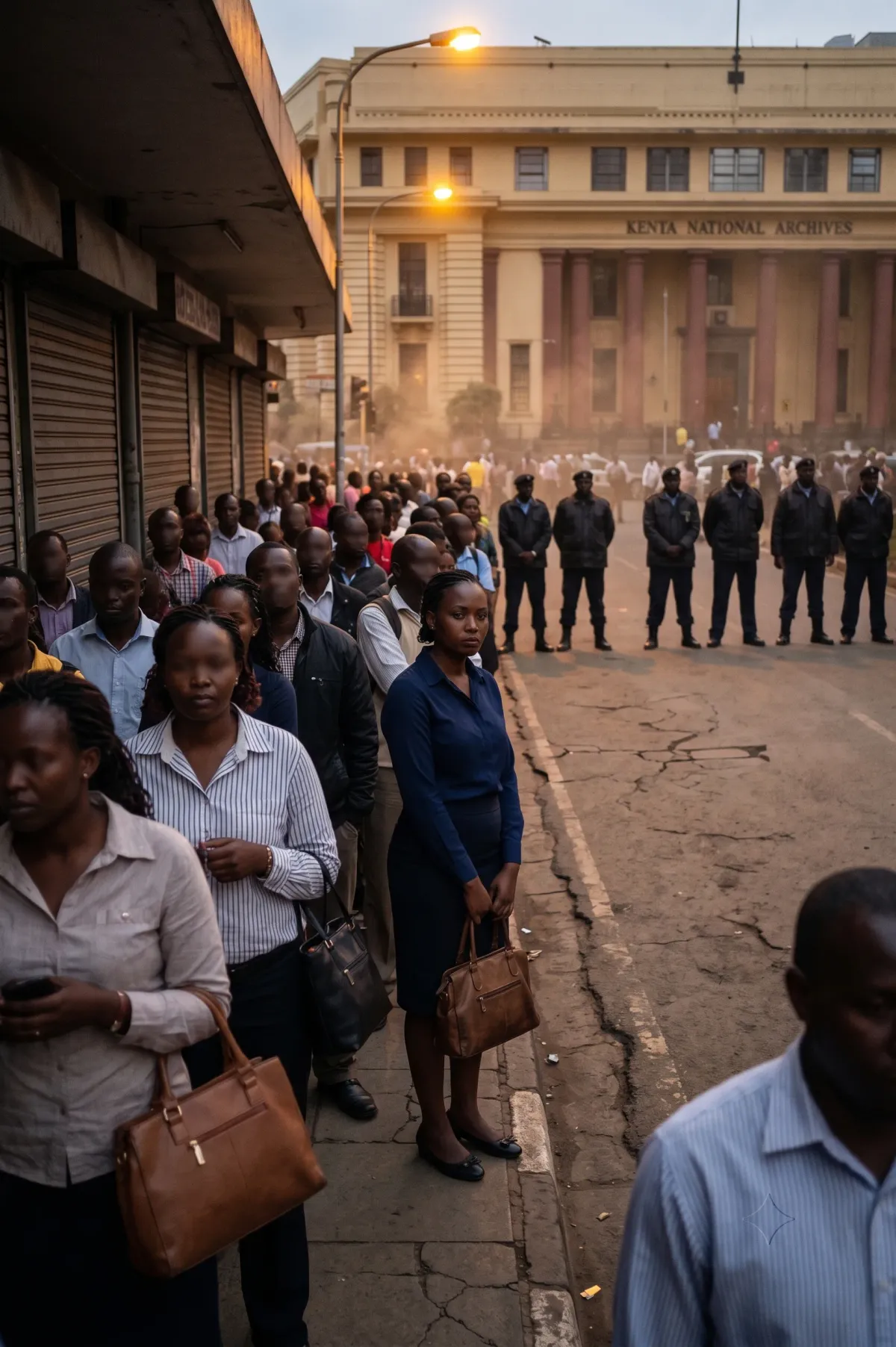
At ten minutes to six, outside Archives, Nairobi discovered that it could still form a government without a ballot box.
It began with a line of commuters who thought they were only waiting for the road to open. They stood on the Tom Mboya pavement with handbags tucked under elbows, laptop bags hanging like bad news, children’s sweaters bought in a hurry, and the exhausted faces of people who had already performed politeness for eight hours. Far ahead, where the road should have been breathing, a row of askari [security officers] held the evening in place. Nobody explained anything. Nairobi is a city where explanation arrives after you have already suffered.
Mercy was near the kerb, one shoe slightly loose at the heel, her phone dead in her handbag. She worked reception at a small clinic upstairs in town, where people arrived holding their stomachs and their opinions. All day she had said, “Please sit,” “The doctor will see you shortly,” and “No, NHIF is not the same as cash,” in the voice of a woman whose real feelings had been locked in a drawer. Now the drawer was open. Her feet hurt. Her supervisor would call soon to ask whether she had “planned her movement,” as if ordinary workers moved through Nairobi by drawing arrows on a whiteboard.
Around her the crowd pretended not to be afraid. Office men refreshed their phones with the seriousness of stockbrokers. A student in a graduation hoodie announced that somebody on WhatsApp had said all stages were closed. Somebody else announced that his cousin had just left town in a matatu [shared minibus taxi]. The cousin, naturally, was not reachable. This is how rumours behave in the CBD. They wear a clean shirt and refuse to be cross-examined.
Kevin was the first to become official. He had an oversized blazer, a company lanyard, and the moist confidence of a junior accountant who had spent the afternoon hiding an unfinished report behind Excel tabs. “People, let us not panic,” he said, raising both hands. The crowd disliked the word “people.” It sounded like a meeting.
“Who has panicked?” a woman asked. “Nobody,” Kevin said quickly. “I’m only saying we need order.” Order is a dangerous word in Nairobi because the moment you say it, people ask who elected you. But Kevin had height, a lanyard, and no better idea. Within ten minutes he was standing on the kerb, pointing towards Latema Road, receiving updates, rejecting updates, and repeating the reliable ones with the authority of a man who had discovered his ministry.
Then Amina arrived with a blue basin and saved capitalism from boredom. She sold earphones, chargers, sweets, and the kind of power banks that promised ten thousand mAh with the battery life of a mosquito. She looked at the stranded crowd and saw not suffering but inventory moving in a new direction. From the edge of a broken flower bed she picked four flat stones, wiped them on her kitenge skirt, and marked them with chalk.
“VIP waiting stones,” she called. “Ten bob. You sit, you wait with dignity. Ordinary waiting is free, but it has no respect.” People laughed because the idea was foolish. Then a man bought one because his knees were not foolish. A woman bought another and placed it carefully under herself as if lowering into business class. Soon Amina was collecting stones from everywhere: under a newspaper stand, beside a closed kiosk, near the foot of a streetlight. She marked them with numbers. VIP 1. VIP 2. VIP 3. The pavement became a lounge. Poverty, when handled by Nairobi, often first passes through comedy so it can be carried.
Mercy did not buy one. She was still committed to the lie that this was temporary. Any minute the askari would move, engines would cough awake, touts would start shouting routes, and the evening would return to its usual unfairness. She would squeeze into a vehicle, pay through M-Pesa [mobile money] if the conductor was not in a cash mood, and reach home with a face arranged into apology.
But the road stayed closed. The sky lowered itself behind the buildings. Shops began pulling down shutters with the metallic finality of people who had accepted the day’s verdict. The crowd thickened into a small republic. Kevin, now fully captured by responsibility, began arranging people by destination. “Umoja this side. Rongai, don’t mix yourselves. Kasarani people, please, you are blocking information.”
“Information has a road?” Amina asked. “It has a direction,” Kevin said. “Then sell it fare.” Even Mercy smiled. She hated that she smiled. There is a type of laughter that leaves your mouth before pride can stop it.
By then the VIP stones had become more than seats. They were rank. A man with VIP 6 refused to stand for a woman with no number until the crowd shouted him into humanity. Amina introduced a waiting list. Someone asked whether stones could be transferred. Someone else wanted to know whether sitting on two stones counted as fraud. Kevin said they needed a register. Amina told him to buy an exercise book if he loved paperwork so much.
That was when the matatu appeared. It came from the wrong side, nosing past a gap as if it had bribed the evening with charm. It was old, cream and green, with a cracked side mirror and a conductor hanging from the door like punctuation. The crowd saw it at once and made the sound Kenyans make when hope enters a place without enough chairs.
“One seat!” the conductor shouted. His name was Karanja; if it was not, the city gave it to him immediately. Every conductor in a crisis becomes Karanja. “One seat only. Exact fare. No bargaining. No standing. No M-Pesa. Cash!” The republic collapsed into a marketplace.
“I was here first.” “My child is alone.” “I have a patient.” “I have a receipt.” “Which receipt?” “For waiting!” Amina lifted both hands. “Receipts are extra.”
Karanja stood on the step and listened like a magistrate who had skipped lunch. He did not only want money; money was now too common. He wanted urgency with evidence. Nairobi had trained him well. In a city where everybody is late for something, the winner is the person whose lateness can make a crowd look away first.
Kevin tried to restore order. “Let us use numbers.” “Your numbers or her stones?” somebody asked. “Both,” Kevin said, then regretted it because two systems are how corruption enters a room.
Mercy found herself pushed forward without deciding to move. She had exact fare folded inside the pocket of her handbag. She also had nothing dramatic. No child at a gate. No hospital call. No photo to raise like a flag. Only a dead phone, a supervisor with a talent for small cruelties, and the fear of arriving home so late that her own life would feel borrowed.
Karanja’s eyes moved over the crowd. “Who has a real emergency?” Every hand went up. Nairobi is an emergency with rent.
A man in a tie said he had a meeting. The crowd booed him because meetings had already taken too much from the country. A student said she had an exam in the morning. That received sympathy but not surrender. A woman said she had left beans on the stove. That almost won until someone asked whether the beans had been cooking since lunch, and the woman lowered her eyes in a way that suggested the beans were a campaign strategy.
Mercy was close enough now to smell the matatu’s warm metal and old seat foam. Her throat tightened. She disliked public need. At the clinic she managed other people’s need from behind a desk; she handed out forms, controlled queues, called names. Need had a system there. Here it had elbows.
“I have exact fare,” she said. Karanja leaned down. “Everybody has fare when one seat remains.” “I have to get home.” “Everybody lives somewhere.” The crowd laughed, not cruelly, but with the tired agreement of people who knew truth when it insulted them.
Mercy opened her handbag for the fare and the dead phone slipped out, hitting the pavement face up. The black screen showed everyone nothing. That nothing embarrassed her more than a cracked screen would have. It said she could not call, could not prove, could not beg properly in a city that had moved proof into devices.
Amina picked it up and handed it back. For once she did not make a joke. Kevin looked at Mercy, then at the road, then at his own phone buzzing in his hand. His boss’s name flashed across the screen. He declined the call with the courage of a man postponing unemployment.
“Let her go,” he said. The crowd turned on him. “Why?” “Because she has been quiet the longest,” he said.
It was not law, but it sounded like something a tired country could accept for one minute. Even Karanja paused. There are moments when a crowd, having built a cruel machine, becomes frightened by how well it works.
Amina reached into her basin and pulled out a small flat stone marked VIP 17. She pressed it into Mercy’s palm. “For the record,” she said. “You were processed.” Mercy almost laughed, but her eyes were hot. She gave Karanja the cash and climbed in before the republic changed its mind. The seat was narrow, polished by many journeys. Someone inside shifted their knees without kindness but with room. Karanja banged the side of the vehicle twice. The matatu pulled away slowly, as if leaving a funeral.
Through the window Mercy saw Kevin back on the kerb, trying again to separate Kasarani from Umoja, his lanyard shining under the streetlight like a government seal. Amina was already marking new stones. The askari line had not moved. The official city remained silent, but the pavement had minutes, numbers, ranks, appeals, fraud, compassion, and receipts. It had become, in other words, familiar.
Mercy’s phone stayed dead in her handbag. For the first time that evening, nobody could reach her, accuse her, summon her, or ask whether she had planned her movement. The silence felt less like failure and more like shade.
At the next junction the matatu stopped to let in cold air and a man who was not allowed to board. He pleaded through the window until Karanja shook his head. The vehicle moved on, carrying its one small injustice away from many others. Mercy looked down at the stone in her hand. The chalk had dusted her palm white.
Para evitar comparaciones innecesarias, conviene decidir la talla aproximada de la persona que llevará la prenda. La información disponible resulta más completa si permite comprobar el color y los elementos gráficos descritos. Para ampliar la información, conviene consultar «» y revisar recomendaciones prácticas relacionadas con el tema. En la fase final, es recomendable comprobar la disponibilidad actual del modelo.
Much later, at home, after she had warmed tea and removed her shoes at the door, she placed the stone on the kitchen counter beside her keys. It looked useless there, a piece of pavement that had followed her indoors. But when the phone finally accepted charge and began coughing up missed calls, Mercy did not pick it up immediately. She watched the stone instead.
Outside, the estate settled into night. Somewhere in town, the pavement Sacco was still calling numbers, still selling patience, still deciding whose tiredness was heavier. Mercy rubbed the chalk between her fingers until VIP 17 blurred, and the little stone sat quietly under the kitchen light, no longer a joke, not quite a receipt, but proof that for one evening Nairobi had made even waiting something you could hold.
衣装を購入する前に、使用日から逆算して納期と試着時間を確保しておくと安心です。複数の候補を比較する際は、文化祭 コスプレ衣装で仕様の違いを確認できます。使用後は素材に合う方法で手入れし、装飾を傷めない形で保管することが大切です。
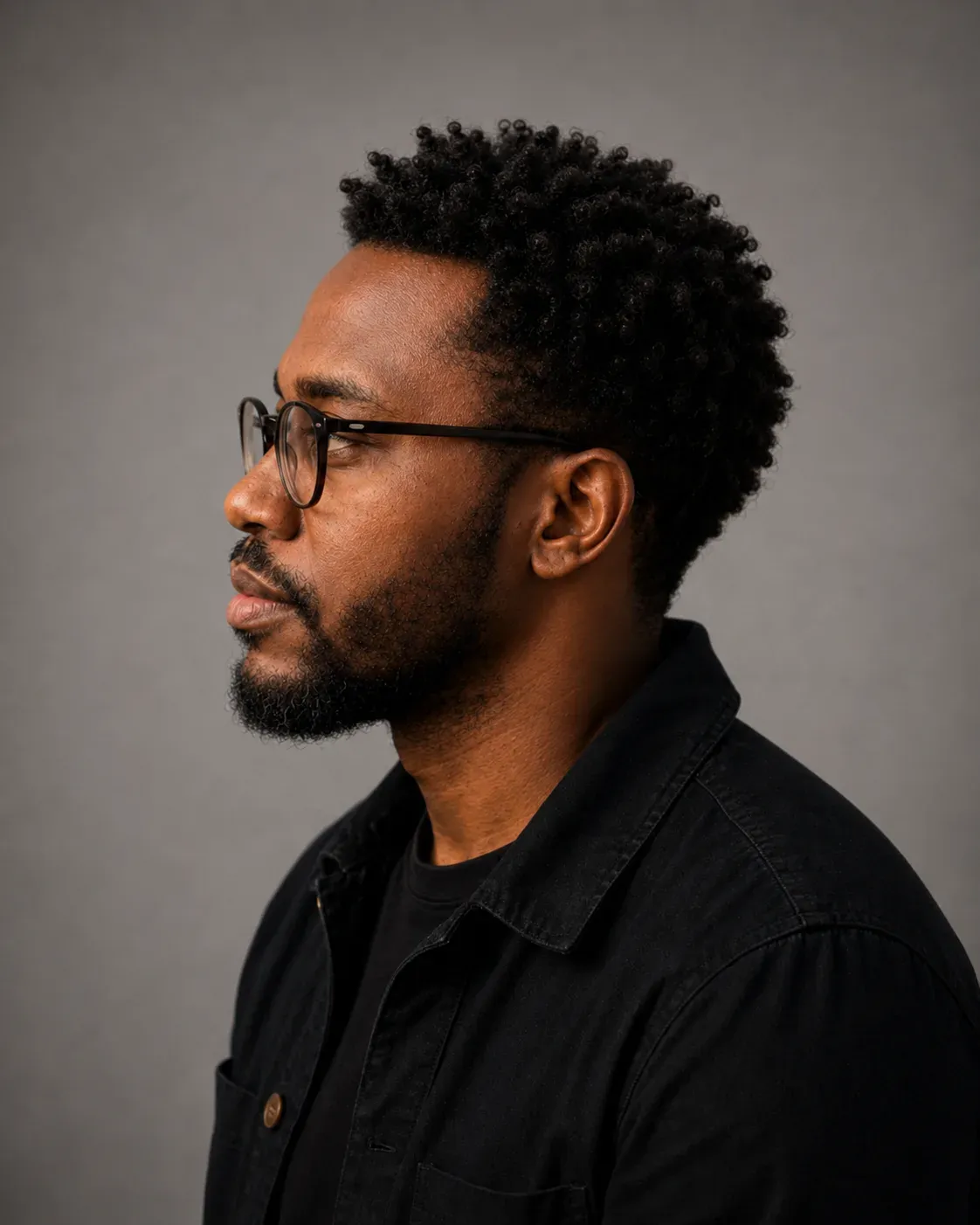
Jaba Man
Jaba Man · Kenyan writer. Fiction and true stories from everyday Nairobi.