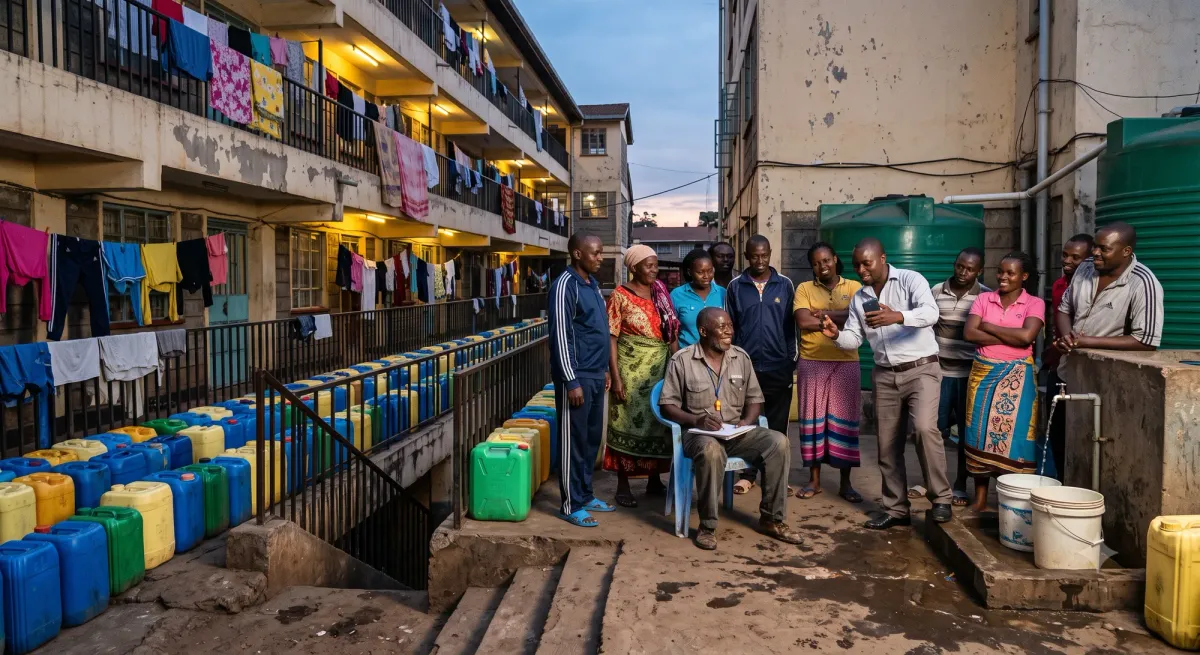
The first day the water disappeared, nobody in Greenview Court said anything. This is how Nairobi estates behave before a crisis admits itself. People open taps, hear that dry metallic cough, then close them quickly, almost politely, as if the tap has only cleared its throat and will now remember its manners. Nobody wants to be the first person to type, “Guys, kuna maji? [is there water?]” because that question undresses you. It tells strangers in Block C that your bucket is empty, your towel is still dry, and your standards have started negotiating with your armpits.
So the first day passed with silence. On the second day, politeness arrived wearing a nightdress. “Morning neighbours. Is anyone else experiencing low pressure?” Low pressure. Kenyans have a gift for calling a funeral “a small issue.”
“Same here in Block B.” “Block D also.” “Any update from management?” Then came the prayer hands. Then the sticker of a cartoon man fainting in a desert. Then a voice note from someone who had not yet learnt that voice notes are not podcasts.
By the third day, the WhatsApp group had stopped being a WhatsApp group. It had become a country.
Every country needs a president, but Greenview Court skipped democracy and appointed a Minister of Water. His name was Otieno, House 4B, a man who sold imported car headlights from the boot of his Toyota Fielder and always knew a guy. He knew a tanker guy in Ruiru. He knew a borehole guy in Dagoretti. He knew a fundi [repair technician] who could listen to a pump and tell whether it was sick or pretending.
“Guys, I am following up,” he typed. That is how power begins in Kenya. Not with a constitution. With “I am following up.”
Soon, Otieno was posting schedules. Block A would fill from 6 to 7. Block B from 7 to 8. Nobody should bring more than two jerricans. Anyone found jumping the queue would be removed from the group. The WhatsApp admin, who had once used his powers only to delete birthday memes, suddenly discovered the cold pleasure of authority. The jerricans lined the stairwells like blue citizens waiting for IDs.
Mwangi, the caretaker, became the border police. He sat by the gate on his plastic chair, newspaper folded on his lap, whistle around his neck as if water had asked to be refereed. Normally he was the man you called when token imeisha [the prepaid electricity has run out] and the meter box had swallowed your dignity. Now he was the man who decided whose bucket would sleep wet. “Sawa [okay], sawa,” he kept saying, which in a crisis can mean anything from “I have heard you” to “go and suffer elsewhere.”
At the edge of the estate, beside the small kiosk that sold airtime and boiled eggs, Millicent ran a salon called Millie’s Touch. The signboard had a woman with hair so glossy it looked like it had shares at the Nairobi Securities Exchange. Inside, there were two dryers, three cracked mirrors, a poster of hairstyles from 2014, and the warm chemical smell of relaxer, braids, and ambition.
Millicent had water.
Not plenty. Plenty is a word people use before the universe laughs. She had three blue conditioner drums behind the curtain in the back room. Two nights before the taps coughed themselves empty, she had filled them because the water had looked at her strangely. Women who run salons develop small prophecies. They can tell when a client is about to say, “Just trim kidogo [a little],” and still expect a new personality. They can tell when a landlord’s smile is carrying bad news. They can tell when water is about to leave.
So she filled the drums, covered them with old towels, and told nobody. In the group she was quiet. She sent “Amen” when Mama Ryan posted morning devotion. She sent a thumbs-up when Otieno announced the tanker. She watched the estate become a parliament of dry people.
The landlord appeared only after someone asked whether service charge included imaginary water. He was called Mr. Muriuki, though nobody had seen him in months. He lived elsewhere, which is the first qualification of many landlords. His message came at 11:42 p.m., the hour when reasonable people are sleeping and unreasonable people are forwarding invoices.
“Dear tenants. Water is a lifestyle, not a utility. You are paying for infrastructure. Whether water comes today or tomorrow is between us and the provider. Rent remains due on the 1st.”
For a moment, even the stickers froze. Then Greenview Court rose.
A man in Block D typed, “Lifestyle? We are flushing toilets with mineral water.” Mama Ryan said, “May God touch his heart,” which was Christian language for, “May God slap him first.” Someone suggested a harambee [community fundraiser] to buy a private tanker, then immediately added that people who had not paid last month’s security contribution should not benefit. This is the problem with community in Nairobi: it arrives carrying receipts.
By evening, the estate had a committee. Otieno was chair. Mama Ryan was welfare. A quiet accountant from Block C became treasurer because he wore spectacles and never used emojis. Mwangi was logistics, though nobody trusted him fully. They called it the Water Taskforce. Kenyans can turn thirst into minutes and action points.
Millicent listened to the voice notes while washing Njeri’s hair with water from a small basin. She poured carefully, cup by cup, like a priest baptising someone who had paid in instalments. “Imagine he is still asking for rent,” Njeri said from the sink. “Landlords don’t live with us,” Millicent said. “They live above us.” Njeri laughed, then stopped because laughter shakes water off the scalp.
That was when Millicent heard her own drums breathing behind the curtain.
It is not easy to hoard in a place where walls are thin. A secret in an estate does not remain a secret; it starts paying rent in other people’s mouths. By the fifth day, people looked at each other differently. You could greet a neighbour and still count the jerricans outside their door. You could say “good morning” while your eyes asked, “Why is your child’s uniform so clean?”
Mwangi came to the salon that afternoon. He stood at the door with the tiredness of a man who had been abused by both tenants and pipes. His shirt had dark moons under the arms. His whistle hung uselessly on his chest.
“Millicent,” he said. “Niko na kiu [I am thirsty].”
She did not move. Behind her, the drums sat in the cool dark, blue and silent. She wanted to say she had none. She wanted to say business had finished everything. She wanted to say many things that are technically lies but emotionally understandable.
Mwangi looked past her shoulder. He knew. She knew he knew. “Sawa,” he said, and stepped back.
That evening, Greenview Court held its meeting at the gate. People arrived carrying jerricans, not because there was water, but because hope in Kenya likes props. Children sat on the pavement licking dusty ice pops. Someone’s sufuria [cooking pot] clanged against the stairs. The taps in the courtyard coughed once and went quiet, like old men refusing to testify.
Otieno stood on the low flowerbed and cleared his throat. “We need order,” he said. People nodded. Dry people love order until order reaches their door. “We also need honesty,” Mama Ryan added, looking around with the soft violence of church women.
That is when Mwangi looked at Millicent’s salon.
No accusation was spoken. None was needed. Estates have their own weather. A silence moved from the gate to the kiosk, from the kiosk to the salon door, from the salon door to Millicent’s chest.
She could have stayed inside. She could have let them talk. She could have waited for the tanker and guarded her drums like a small corrupt government. Instead, she went to the back room and rolled out the first blue drum.
The courtyard became still. Then the second. A child whispered, “Maji [water].” Then the third.
Millicent did not explain. Explanations are for people who still believe they will be understood. She fetched a plastic cup, dipped it into the first drum, and handed it to Mwangi. “Start with the old man in 1A,” she said. “Then the children. Then whoever is shouting the least.”
Nobody clapped. Clapping would have made it theatre, and thirst is not theatre when your toilet has become a rumour. Otieno removed his cap. Mama Ryan began writing names in a notebook. The accountant from Block C started calculating litres per household with the seriousness of a man dividing an inheritance. Even the WhatsApp admin lowered his phone.
Water moved through the courtyard cup by cup, basin by basin, shame by shame. By the time the old man in 1A had taken his share and the children had carried small buckets upstairs, the estate had stopped looking at Otieno. They still called him chair because Kenyans respect titles the way we respect plastic flowers in offices. But when someone asked how much was left, their eyes went to Millicent.
That was the punishment hidden inside goodness. Once people see you can save them, they stop allowing you to be ordinary.
When Mr. Muriuki finally typed that a tanker would arrive “soonest,” nobody replied. His country had fallen while he was composing English. The committee agreed that rent could wait for a meeting with minutes. For the first time that week, the WhatsApp group went quiet without fear. It was the silence of people listening to a new tap opening somewhere inside themselves.
At nine, Millicent returned to the salon. There was not much water left. Enough for one head, maybe two if the clients were patient and God was economical. Her phone kept lighting up on the counter. “Proposal: permanent water committee?” “Can we audit service charge?” “Who has contacts for a cheaper tanker?” “Millicent, uko [are you there]?”
コスプレ衣装を選ぶ際は、サイズ表、素材、付属品、発送予定日を確認すると比較しやすくなります。具体的な候補を確認する場合は、ナース コスプレ 衣装 ピンクから関連する商品や情報を比較できます。商品が届いたら付属品とサイズを早めに確認し、必要な調整を本番前に済ませましょう。
She did not answer. She took the last cup from the basin and rinsed one black comb slowly, tooth by tooth. Outside, Otieno was still talking about order, but the blue jerricans had turned slightly toward her door, upright and patient, like voters who had finally learnt that a promise is only as useful as the person willing to spend their last cup.
Una búsqueda bien orientada comienza por identificar la opción entre camiseta local, visitante o alternativa. También es necesario valorar el ajuste indicado según el uso previsto. Entre los recursos de apoyo, «» facilita la tarea de reunir datos útiles antes de tomar una decisión. En el control final, conviene comparar la opción elegida con las alternativas consideradas.
Jaba Man
Jaba Man · Kenyan writer. Fiction and true stories from everyday Nairobi.