The Matatu That Started Remembering
On an Embakasi nganya, paid adverts are supposed to make the evening commute feel clever and expensive. Then one screen starts showing the private debts, bargains, and borrowed respectability of regular passengers, and the matatu learns that attention is never as harmless as it looks.
The Matatu That Started Remembering
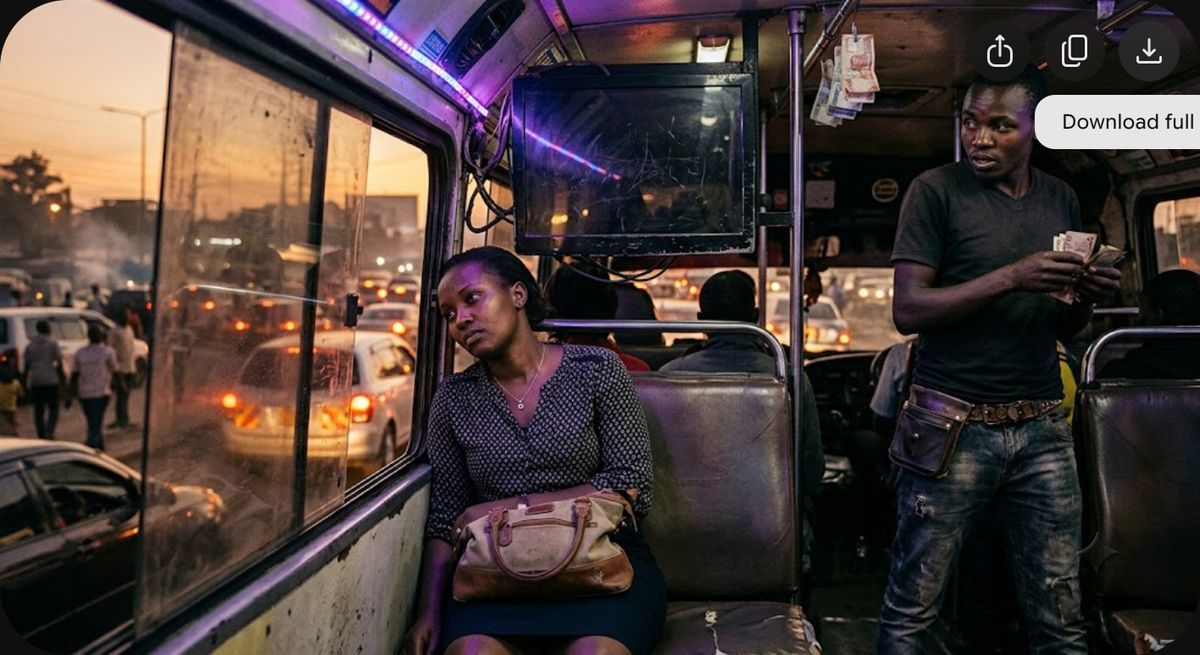
The Embakasi nganya [flashy decorated matatu] was called The Oracle, because Nairobi has reached that place where even a fourteen-seater must have a prophecy. It had purple lights under the seats, two small screens screwed near the roof, and a sound system that did not play music so much as occupy your chest and rearrange your small organs.
At the stage, people did not say, “I am boarding a matatu [shared minibus taxi].” They said, “Leo niko kwa Oracle.” Today I am in The Oracle. As if it was not going to join the same Mombasa Road traffic as everyone else and inhale the same exhaust from lorries carrying sand.
Chebet liked it anyway. She was an accounts clerk in Industrial Area, which means she spent her day looking for missing shillings in spreadsheets while men with clean shoes asked whether she was “almost done.” By the time she reached the stage, she did not want wisdom. She wanted noise. Noise is underrated. Noise can cover the sound of your landlord’s message, your mother’s missed call, your own thoughts walking around the house with muddy shoes.
The Oracle gave her noise with interest.
Mutiso, the driver, treated the vehicle like a child he had taken to private school. He wiped the dashboard with a yellow cloth. He threatened boys who leaned on the paint. He had installed the screens after watching another route make passengers clap for a matatu as if it had passed KCSE. The screens played music videos, comedy clips, sometimes a pastor shouting into a microphone with the confidence of a man who had never been asked to reverse into a tight parking spot.
Kasee, the tout [fare collector], worked the door with a coin belt across his chest and the alert eyes of a man who could tell by your shoes whether you would pretend not to have change. He had a small black notebook tucked behind his fare receipt pad. Nobody asked about it. In Nairobi, everybody has a notebook somewhere. Some are in handbags, some in M-Pesa statements, some in the heart. They all say the same thing: you owe, you are owed, remember.
That Tuesday evening, Chebet boarded at the usual time and found her favourite seat by the window. The Oracle smelled of pine air freshener, warm vinyl, and the faint panic of people trying to get home before rain. Pastor Mwaura sat in the third row, wearing a grey suit and the face of a man who had advised many marriages without ever admitting that supper can also be a battlefield. Kasee clicked coins into his palm. Mutiso adjusted the volume with two fingers, delicate as a surgeon.
Then the screens changed.
No music video. No comedian pretending to be a drunk uncle. No pastor sweating under lights. A blue slide appeared with stars flying in from the corners, the kind of design made by a printer who has discovered PowerPoint transitions and will not be stopped by family or law.
“Advert time,” Kasee announced. “Local businesses, support mtaani [in the neighbourhood].”
The first slide was harmless. OMOS PRINT & DESIGN. Business cards. Posters. Wedding programmes. Funeral programmes. Banners for harambee [community fundraising]. Laminating while you wait. The passengers watched with the dead patience of people being sold things in traffic. Someone near the back said the printer should also advertise jobs. Someone else said jobs are not printed, my friend, they are inherited.
The next slide showed a WhatsApp screenshot.
At first nobody understood what they were seeing. Screenshots are the national wallpaper now; they appear everywhere like mosquitoes. Then the matatu grew quiet in the exact way a room grows quiet when a cup falls but does not break. On the screen, Pastor Mwaura was bargaining with Omondi of Omos Print about flyers for a kesha [overnight church vigil].
Pastor Mwaura: My son, this price is too high. This is God’s work.
Omos Print: God’s work also needs toner, Pastor.
The Oracle did something rare. It lowered itself without Mutiso touching the volume. Even the bass seemed to step aside and give shame the aisle.
Pastor Mwaura kept looking out of the window, but his ears betrayed him. They turned red first, then the red moved slowly to his neck. He had the stillness of a man pretending not to be home when the landlord knocks, except the landlord had entered through the roof and brought a projector.
From the back, a young man whispered, “Pastor, si you pray toner ipungue?” Pray that toner becomes cheaper?
A few people laughed, then swallowed the laughter quickly because they had also bargained somewhere with the authority of suffering. Chebet had once asked a tailor to reduce the price of altering a dress by saying she was a regular customer, even though she had only been there twice and one time was to ask directions. Bargaining is not sin in Nairobi. It is weather.
The screen moved on before the pastor could defend himself. A photo appeared of a young man in a university hoodie, smiling with the brightness of a brochure. The caption congratulated him for “following his passion” into hospitality. His mother, who was sitting beside him with a shopping bag on her knees, turned slowly. That turn carried school fees, church announcements, aunties who say “our engineer,” and a father who had told three tables at Christmas that his son would one day build bridges.
“Hospitality?” she asked.
The young man looked at the window as if the answer had been written on Enterprise Road.
This time nobody laughed. There are lies people tell because they are wicked, and lies people tell because hope has become a family project with too many investors. Chebet watched the boy’s jaw tighten and understood that the matatu had not exposed a course. It had exposed a whole committee of expectations sitting on his chest.
Mutiso kept driving. His eyes flicked once to the mirror. He was beginning to understand that his beautiful screens, his proud upgrade, his proof that The Oracle was not an ordinary matatu, had become a witness box. But traffic was traffic. A man can have a moral crisis and still need to beat a bus before Nyayo.
The advert continued. Omos Print had apparently decided that customer testimonials were stronger when presented as evidence. A chama [informal savings group] poster came with a screenshot of women arguing over whose turn it was to host. A birthday banner came with a caption that revealed the birthday girl was thirty-eight, not thirty-five as she had announced with cake. Each slide tore a tiny curtain. Not enough to ruin a life completely. Just enough to let neighbours see the plastic basin behind the sofa.
Then Kasee’s name appeared.
It was small, tucked into a payment list below three other names, but debt has a way of enlarging itself in public. KASEE — BALANCE 1,850. Under it, in red: promised Friday. Friday had passed. Maybe two Fridays had passed. The matatu did not know mercy. It enlarged the slide with another star transition, as if the debt had won a raffle.
Kasee stopped moving.
The coins in his hand went quiet. For a tout, silence is not natural. A tout is made of movement: fare, change, door, insult, whistle, balance, next stage. Kasee stood with one hand on the rail and the other near the small black notebook behind his receipt pad, as if the notebook had suddenly become a living animal that might bite through his shirt.
“Kasee,” someone said softly, not teasing now. “Hii nayo?” What about this one?
He tried to smile. The smile came out wrong, like a shirt buttoned in darkness. “Small balance tu.” Just a small balance.
Small balances are the ones that finish people. Big money has meetings, lawyers, payment plans, tea in boardrooms. Small money stands at your door in the evening and calls your name where neighbours can hear. One thousand eight hundred and fifty shillings can become heavier than a title deed if it is displayed above your head in purple light.
Pastor Mwaura cleared his throat. Perhaps he wanted to rescue the situation. Perhaps he wanted to remind everyone that all men fall short. But he had already fallen short of toner money, so the sermon remained seated.
Chebet looked at Kasee and saw, for the first time, that his noise had been armour. The jokes at the door, the quick fingers, the way he called every woman “siste” and every man “boss,” all of it was a uniform. Under it was a man trying to outrun a notebook. The same city that laughed at him owed someone else in another vehicle, another kiosk, another chama, another phone.
“Mutiso, zima hiyo kitu,” Kasee said. Switch that thing off.
Mutiso reached up at the next crawl of traffic and pressed a button. The screen went black. The silence that followed was not peace. It was what remains after a joke discovers it has teeth.
For a while The Oracle moved like any other matatu. It lurched, braked, swallowed dust, coughed music from speakers now playing too low. People looked at their phones with great concentration, the way Kenyans look at phones when they are avoiding another person’s pain. Pastor Mwaura typed something and deleted it. The young man’s mother folded her shopping bag smaller and smaller until it became a weapon of paper and disappointment.
At the stage, nobody rushed to alight. That was the first strange thing. Usually people fight the door before the vehicle has stopped, as if home will expire. That evening they waited. Kasee stood aside, suddenly too polite. He counted the fares and came up short. Of course he came up short. Shame affects arithmetic.
Chebet had already stepped down when she heard him count again. Mutiso watched him from the driver’s seat. Nobody said the amount. Nobody needed to. Public money, like public embarrassment, announces itself without a microphone.
Pastor Mwaura was the first to put a note on the engine cover. He did it without looking at Kasee, which was either kindness or pride; in Nairobi those two sometimes share a shirt. The mother of the hospitality boy added coins from the corner of her handbag. Chebet added fifty bob. Someone at the back complained that people were now doing harambee for debts inside a matatu, but he also added twenty because complaint is not the opposite of generosity. It is often its cousin.
Kasee did not thank them loudly. Loud gratitude would have made the thing bigger. He only touched the notes, nodded once, and pushed the small black notebook deeper behind the receipt pad. The notebook was still there. Debts do not disappear because people become kind for one evening. But its weight had shifted. It was no longer sitting on his chest alone.
Mutiso started the engine again. The Oracle’s purple lights blinked back on, unsure of themselves. The screen above Chebet stayed dark. In its black face she could see Kasee at the door, Pastor Mwaura adjusting his cuffs, the boy and his mother standing apart but not far, and herself with her handbag pressed to her side as if privacy was something one could hold shut with an elbow.
From someone’s cheap phone speaker, the Omos Print jingle began playing again, thin and stubborn, probably from the advert forwarded to a WhatsApp group already doing what Nairobi does best: turning pain into content before the dust settles.
Chebet walked home slowly. Behind her, The Oracle joined traffic, lights low, screen dark, carrying people who now knew one another slightly more than they had paid for. In the reflection, just before the matatu pulled away, the black screen held them all together for one second: passenger, pastor, tout, driver, evening road, and the small unpaid things travelling with them.
Antes de iniciar la búsqueda, conviene definir la necesidad de una prenda suelta o una equipación completa. Un criterio objetivo exige confirmar que la descripción coincide con las imágenes. Una consulta como «» permite evitar que la elección dependa solo del título del resultado. Antes de finalizar el pedido, merece la pena revisar el estado indicado en la ficha.
Jaba Man
Jaba Man · Kenyan writer. Fiction and true stories from everyday Nairobi.