The Homework Uncle
A Class Seven boy in Eastleigh asks a patient app the questions adults are too tired to hear, until his mother discovers what the phone has become in their home.
In the Eastleigh flat, supper announced itself before anybody sat down. Onions hit hot oil and became a whole speech. The pressure cooker hissed like it knew secrets. From the mosque down the road came the last call of the evening, soft and stretched, and from the corridor came the slap of slippers, children being called back inside, a neighbor laughing too loudly at a video on his phone.
Baraka did his homework at the small table by the socket, because the socket was the most important relative in that house. It held the extension cable, the iron, the kettle, the cracked Android phone, and sometimes, when there was token [prepaid electricity credit], the little rechargeable lamp that had lost one eye. He was in Class Seven [seventh year of primary school], that age where a boy is still small enough to be sent for tomatoes but old enough for adults to lower their voices when he enters the room.
His mother, Amina, sold hair products from a glass shelf inside her cousin's salon and carried the day home in her shoulders. She came in smelling of setting lotion, dust, and the particular fatigue of smiling at customers who asked for a discount before greeting you. She would drop her handbag on the sofa, remove her shoes with her toes, and ask Baraka, “Umemaliza homework? [Have you finished homework?]” before she even removed her headscarf.
At first the phone helped him with ordinary things. Composition: My Best Friend. Science: functions of the kidney. Social studies: why the River Tana is important. The app answered everything with the calm manners of a bank manager who has already eaten lunch. It never pinched its nose and said, “Baraka, surely.” It never asked why he had forgotten what the teacher had explained. It never told him to stop disturbing people.
That is how children begin to trust things. Not because the things are wise, but because they are patient.
Baraka liked the patience. He liked typing a question badly and being understood. He liked that the answer came without a sigh. In school, Teacher Ruth had thirty-eight children and one red pen that moved through their books like a small wounded animal. At home, his mother had rent, food, fare, electricity, and relatives who called with emergencies that had no shame. The phone had none of those problems. The phone had time.
On a Monday evening he asked it how to write a speech about discipline. On Tuesday he asked it why some boys grew beards early. On Wednesday he asked what to say when aunties at family functions asked why he was thin. The app told him to smile politely and say he was eating well, then ask about their children.
This impressed him. It was not only an answer; it was a weapon wrapped in manners.
At the next family gathering in Pangani, when Auntie Muthoni pressed his arm between two fingers and said, “Haiya, Amina, this boy is disappearing,” Baraka smiled and asked, “How is Brian doing in college?” The auntie released his arm as if it had become hot. Amina looked at her son from across the room with a face that said, where did you learn that? Baraka bent over his Fanta and hid his smile inside the straw.
After that, the questions changed clothes. They still looked like homework from far, but inside they had grown a heartbeat.
What do you do when your mother is sad but says she is just tired? How do you ask for school fees when you know there is no money? If your father does not call, does it mean he forgot you? The app answered in clean paragraphs. It said adults sometimes carry burdens children cannot see. It said absence was not proof of being unlovable. It said he could tell his mother he appreciated her. It said he should speak with a trusted adult, which made Baraka laugh softly in the dark because trusted adults in Kenya are the same people who tell your business at the next chama [informal savings group].
He had a father somewhere. That is how Amina phrased it when she was cornered: “He is somewhere.” Somewhere was a large country. It had no capital city, no phone number, no fare stage. Somewhere had swallowed a man called Dennis who used to repair fridges, wear sharp shoes, and promise to come on Sunday. In the beginning Sunday meant a day. Later Sunday became a style of lying.
There was also Uncle Steve, who lived in Kitengela and sent long voice notes during December saying family was important. Uncle Steve was very good at family in audio form. When school opened, he became mteja [unreachable by phone]. The phone would ring and ring, then a woman's voice would say the subscriber could not be reached, as if the whole country had tried and failed.
So Baraka asked the app things uncles used to answer before uncles became busy, broke, saved by Jesus, or employed by excuses.
How do I become a man? Can a man be quiet? If I am scared, should I tell my mother? The answers were not perfect. Sometimes they sounded like a guidance-and-counselling poster that had gone to university abroad. But they were there. At night, under the blanket, the phone lit his face blue. Outside, a boda [motorcycle taxi] coughed past the gate. In the next room Amina counted notes, then counted them again, as if money might multiply from embarrassment. Baraka held the phone close and read slowly, moving his lips over words that did not come from anybody he knew and therefore could not betray him.
Amina noticed he had become careful with her. Not obedient exactly; careful. He stopped asking for new shoes even though the left one smiled at the front. He stopped complaining when supper was tea and bread. Once, when she dropped a sufuria [cooking pot] lid and cursed under her breath, he said, “Sorry, Mum. You have had a long day.”
She stood there holding the lid, suspicious. Kenyan mothers are not used to emotional intelligence arriving in the kitchen without an agenda. “Who are you talking to like that?” she asked. “You.” “Have you broken something?” “No.” “Then go and read.”
He went, but she watched him. Children reveal themselves first through new manners. Bad company teaches slang. Fear teaches silence. A secret teaches politeness.
On Thursday, the school sent pupils home with fee-balance notes. Baraka's was printed on thin paper from the cyber cafe near the stage because the school printer had jammed again. The figure at the bottom sat there with all its zeros, rude and official. He folded the paper into a square and put it inside his English exercise book, between an essay about climate change and a page where Teacher Ruth had written, Good effort, improve handwriting.
At home Amina was on the phone with someone from her chama. One member had delayed contribution and another had suggested prayer, which in chama language sometimes means the money has already developed legs. Amina listened, said “mmh,” said “we cannot continue like this,” and stirred beans with the anger of a treasurer who has seen human nature.
Baraka put his bag down. He wanted to give her the note. He wanted not to give her the note. He wanted to be a child. The house, unfortunately, was not accepting applications for that position. “I’m sorry you are dealing with all that,” he said. Amina stopped stirring.
“What?” “I said I’m sorry. About the chama.” She looked at him the way you look at a radio when it suddenly mentions your name. “Who told you to say that?” “Nobody.” “Hm.”
It was not agreement. It was a mother putting a pin on a map. That night, when Baraka slept, Amina picked up the phone to set the alarm. That is what she told herself. A mother can lie to herself with the tenderness of a thief. The phone opened without asking for a password. The chat was there, bright and waiting.
She read the first questions quickly, smiling despite herself at the one about aunties. Then she read slowly. Then she sat down.
How do I tell my mum I know she cries in the bathroom? What if my father comes back and I don't know how to speak to him? Can I ask my mother if we are poor? How do I stop feeling angry when people say I am the man of the house? Amina held the phone with both hands. The room changed shape around her. The clothes on the chair, the school socks near the bed, the fee note hiding in an exercise book, the half loaf wrapped in a paper bag—all of them became witnesses. She had thought silence was protecting him. She had thought if she swallowed enough worry, he would not taste it. But children live in the mouth of the house. They know what is being chewed.
There are shames that arrive loudly, knocking plates from the table. This one sat beside her quietly. It did not accuse. It simply showed her the space she had left empty, and how quickly a screen had moved in and arranged its furniture.
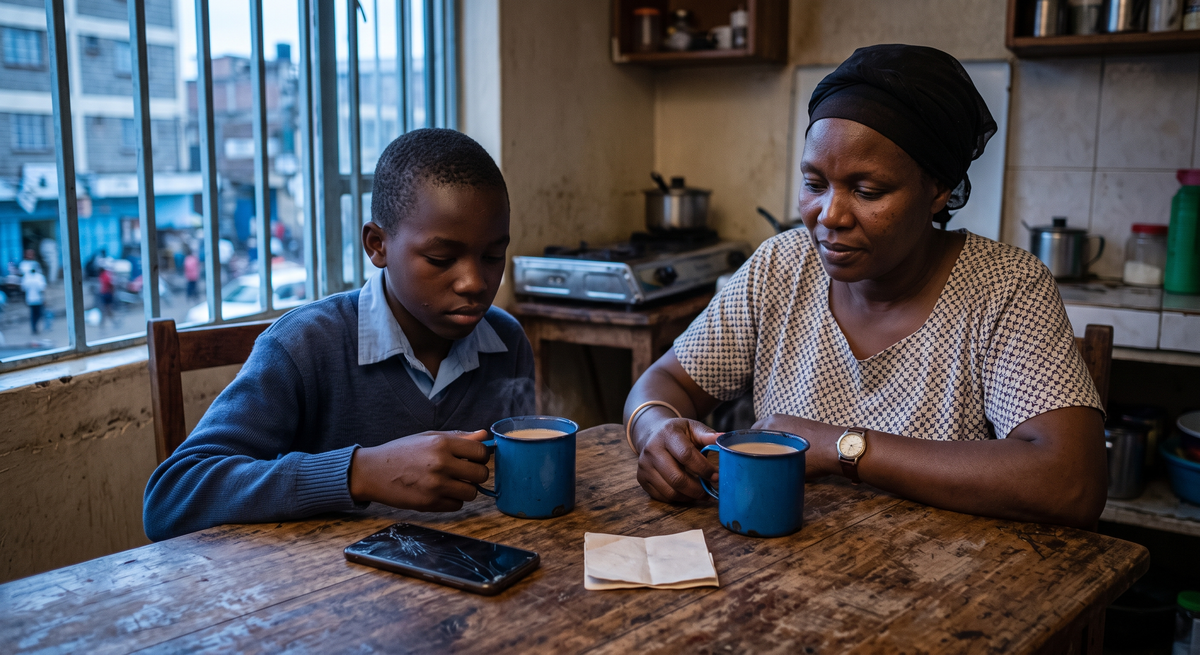
In the morning she did not shout. That was the first miracle. She made tea, placed two cups on the table, and removed the folded fee note from his exercise book. Baraka stood by the doorway in his uniform, his face already prepared for trouble.
“I saw your phone,” she said. His eyes dropped. “I was not supposed to read,” she added. “That one is my mistake.” He looked up then, because adults rarely hand you their mistake without wrapping it in yours.
Amina pushed one cup of tea toward him. “We are not rich,” she said. “But we are not finished. Fees, I will look for it. Your father, I cannot answer for him. But this house, Baraka, this house is not a place where you must go and ask a machine how to talk to your mother.”
The boy swallowed. All his clever answers left him. The app had prepared him for aunties, fees, absent fathers, discipline, and polite disagreement. It had not prepared him for his mother speaking softly. “I didn't want to make you sad,” he said.
“You are my child,” she said. “You will make me sad, happy, broke, proud, tired. That is the contract.”
He laughed once, through his nose. She did too. It was small, but it entered the room like fresh air. Outside, Eastleigh had begun its morning argument: handcarts rattling, matatu [shared minibus taxi] touts calling routes, a woman bargaining for tomatoes as if the economy could be defeated by volume.
Inside, Amina reached across the table and touched the back of Baraka's hand. Not a dramatic touch. Not cinema. Just three fingers resting there long enough to say, before school, before fees, before the world begins shouting, sit here.
The cracked phone lay face-down beside the fee note. For once it had nothing to add. The screen stayed dark while mother and son drank tea in the blue kitchen light, listening to each other breathe.
Jaba Man
Jaba Man · Kenyan writer. Fiction and true stories from everyday Nairobi.