The Dashboard Said More Effort
A young Nairobi debt collector spends the day turning other people’s hardship into dashboard entries, until his own creditor calls him inside a matatu and the script comes back in a voice he knows too well. By night, the cracked headset on his table has stopped feeling like office equipment.
The Dashboard Said More Effort
Kevin Otieno’s headset had a crack on the left earpiece, a small white lightning line across the black plastic. It was the kind of office equipment nobody owned and everybody inherited, carrying old hair oil, stress, and the warm smell of other people’s foreheads. Every morning at eight, when he pressed it over his ears, the office entered his skull before the city had finished clearing its throat.
The room was on the fourth floor of a building in Westlands, behind a glass door with a motivational sticker that had started peeling at the corner. Inside, twenty young people sat shoulder to shoulder, each one speaking into a mouthpiece with the careful politeness of a person holding a small knife behind the back. Good morning. We are calling regarding your overdue facility. Kindly confirm when we can expect payment.
That was the language. Facility, not loan. Commitment, not promise. Outstanding balance, not shame. If you said debt too early, people hung up. If you said auction, Madam Brenda appeared behind you like network coverage returning in a lift.
Madam Brenda supervised the collections floor. She was not old, but she had the settled tiredness of someone who had seen too many excuses try to wear perfume. She moved between desks with a tablet in her hand, reading the dashboard the way pastors read scripture. Green meant you were useful. Yellow meant you were drifting. Red meant your chair had started asking questions.
Kevin’s numbers were yellow before tea. “Kevin,” Madam Brenda said, standing behind him. He did not turn. Supervisors are louder when you look at them. “More effort,” she said.
She said it softly, almost kindly, which made it worse. Some words are not instructions; they are a diagnosis. More effort meant your voice was not convincing enough. More effort meant your rent was your problem but the company target was everybody’s problem. More effort meant the dashboard had looked at your humanity and found it underperforming.
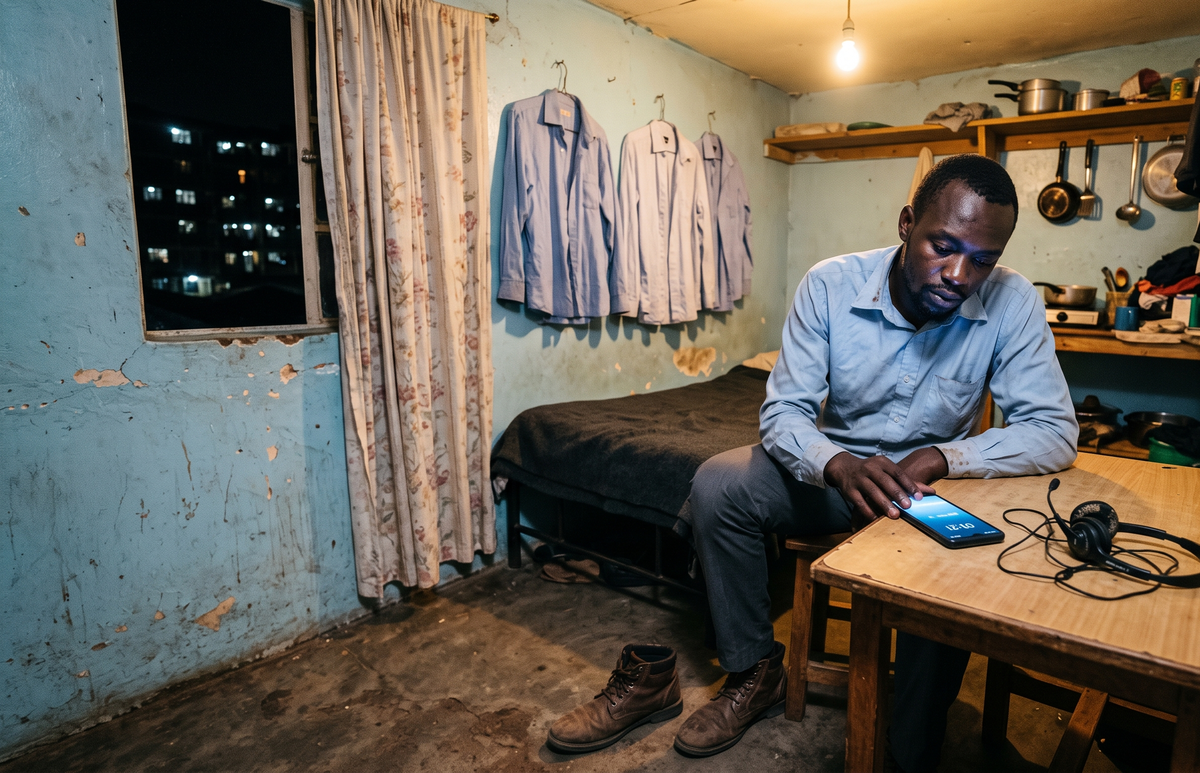
Kevin was twenty-four and lived in Pipeline, in a single room where the bulb flickered when the neighbour ironed clothes. He owned three office shirts. Two were white in the way old teeth are white. The third was blue and made him look like someone who understood payroll. He ironed them at dawn on a towel spread over a plastic table, then walked to the stage pretending not to count the day before it began.
By ten-thirty, he had made sixty-seven calls. Some numbers rang until they became personal. Some people picked and breathed. Some people said, “Wrong number,” with the confidence of citizens who had discovered a constitutional loophole. One man whispered, “Boss, I’m in a funeral,” and Kevin, who had heard three funerals already that morning, said, “Pole sana [sorry], but when can we expect the payment?”
There are jobs that slowly teach you to mistrust sorrow. Debt collection is one of them. Kevin hated that part most. He was not a cruel person. He sent money home when he could. He lowered his voice for old women. He knew hunger had a sound, especially through a cheap phone speaker. But the dashboard did not have ears for hunger. It had columns.
At eleven-fifteen he called a man owing 1,200 shillings. The man listened until Kevin reached the word facility, then passed the phone to a child. “My dad is bathing,” the child said. Kevin looked at the call timer. Behind him, Madam Brenda’s shoes made a small rubber sound on the floor. “Tell your dad Kevin called,” he said. “What is Kevin?” the child asked.
For a second, the office became very quiet inside him. Not outside. Outside, everyone was still collecting, reminding, negotiating. Inside Kevin there was only that question. What is Kevin? A name? A threat? A man wearing a cracked headset so that another man could hide behind a bathing lie? “Tell him it is about payment,” Kevin said, and ended the call.
At lunch he went downstairs and bought two mandazi [fried dough snacks] from a woman whose oil had known better years. He wanted beans but beans required optimism. He stood near the wall, eating slowly, checking his phone between bites. His mother had called twice. His landlord had sent a message without greeting: Kesho mwisho [tomorrow is the last day]. His own loan app had sent a notification dressed in corporate cheerfulness: Keep your record strong.
He opened M-Pesa [mobile money]. Four hundred and thirty shillings. Fare home, fare tomorrow, maybe airtime if he walked part of the distance and refused thirst like a disciplined citizen. He closed the app quickly, as if the balance might reduce from being looked at too long.
When he returned, Madam Brenda had written the afternoon target on the whiteboard. It was not a target; it was a weather report. Everyone saw the storm. Nobody had an umbrella. “Team,” she said, clapping once. “Remember, people pay where pressure is consistent.” The room murmured agreement. Pressure is a beautiful word when you are not the one carrying it.
At two, the singing woman picked up. Her file said she owed 3,800 shillings, nine days overdue, called six times. She always answered as if she had been expecting church. “Madam, this is Kevin from—” Before he finished, she began to sing. Not loudly. Not madly. Just a soft gospel chorus, the kind sung by women who have washed clothes by hand and still believe heaven has a proper accounts department.
“Pesa itakuja [money will come],” she sang. Kevin should have interrupted. Madam Brenda was watching the floor from the printer corner. Instead he let the woman finish one line. It cost him eight seconds, maybe twelve. On the dashboard, mercy had no column. “Madam,” he said when she paused, “we need a clear commitment.” “Even me I need a clear miracle,” she said.
He almost laughed. It rose in his chest and stopped there, because laughter in that room could be mistaken for having energy left.
By four, his ears hurt. The cracked earpiece pressed the same spot until the pain became familiar, like a small relative. He had been insulted in English, Kiswahili, and one language he did not know but understood perfectly. A boda boda [motorcycle taxi] rider had told him, over the sound of traffic and wind, that if the company wanted its money it should come and sit on the bike and help him look for passengers.
A woman had cried without making any sound. A man had promised to pay at six, which in Nairobi is not a time but a philosophy. Kevin logged every answer. Promise to pay. Call back. Not reachable. Dispute. Refused. Deceased, pending verification. The words made human beings small enough to fit in boxes.
At five-thirty, Madam Brenda stopped behind him again. His dashboard was still yellow, though a more hopeful shade of yellow, like a banana trying. “Better,” she said. “But tomorrow, more effort.” Tomorrow. The city’s favourite threat.
He removed the headset and felt the office continue ringing inside his ears. Outside, Westlands was releasing workers onto the road in batches: people with laptop bags, tired shoes, clean perfume fighting sweat. Kevin walked to the stage with his bag pressed under his arm. He had ignored his mother for the whole day. He called her while waiting for the matatu [shared minibus taxi].
“Kevin,” she said, stretching his name until it became a place he could go and rest. “Mum, I’m from work.” “You are eating?” “Yes.” Mothers ask questions whose answers they already fear. She was quiet for a moment, and in that quiet he heard the village evening: a chicken complaining somewhere, a basin being moved, distance pretending to be network.
“Your sister was sent home,” she said. “Fees balance. I told them you are working in Nairobi.” There it was. Working in Nairobi. Three words that make relatives imagine an ATM with a face. “I will see what to do,” Kevin said. “When?” she asked. He smiled sadly because she sounded, for one dangerous second, like him.
The matatu arrived with music already quarrelling with the engine. Kevin squeezed into the back row between a woman carrying vegetables and a young man watching a football clip without earphones. The conductor slapped the side of the vehicle and shouted the route as if announcing freedom. Kevin paid and watched his balance fall in his head before his phone confirmed it.
Somewhere near Kangemi, his phone rang. Unknown number. He let it ring. It rang again. The woman with vegetables glanced at him, not rudely, just with the public curiosity of people trapped together in traffic. Kevin answered.
“Good evening, Mr Otieno,” a woman said. Her voice was polite, firm, freshly trained. “I am calling regarding your outstanding balance.”
The matatu hit a pothole and everyone rose a little from their seats, as if summoned. Kevin held the phone away from his ear and looked at it. Not because he did not understand. Because he understood too well. The woman continued. “We would like to know when you can make payment.”
Around him, Nairobi carried on with its own negotiations. The conductor argued over change. The football boy cursed a striker. The vegetable woman’s sukuma wiki [collard greens] brushed Kevin’s knee with the smell of soil still clinging to the stems. Outside, kiosks switched on blue bulbs one by one.
Kevin could hear the woman waiting for his commitment. He knew her screen. He knew where his name sat on it. He knew the colour beside it. Maybe yellow. Maybe red. Maybe something worse that only supervisors saw. “I will pay,” he said. “When?” He almost gave her one of the good lies. End month. Friday. After salary reflects. Let me call you back. Nairobi has a drawer full of these lies; everybody borrows from it.
Instead he said, “When money comes.” The woman paused. Perhaps she was new. Perhaps nobody had taught her what to do with truth when it did not come wearing a date. “We need a commitment, Mr Otieno.” “I know,” he said.
He ended the call before she could say more effort. The words arrived anyway. They did not need network.
In his room that night, Kevin placed the cracked headset on the plastic table beside his phone. He had carried it home by mistake. Or maybe not by mistake. Some burdens follow you because they know the route.
His mother sent one message: Pole pole mwanangu [slowly, my child]. No demand. No school fees figure. Just that. Slowly.
Kevin sat on the bed without removing his shoes. Outside, someone’s pressure cooker whistled. A neighbour laughed too loudly at something on TV. His phone lit up again with a reminder, blue and clean and patient.
The headset lay beside it, unplugged at last, its little white crack catching the light like a road on a map.
When choosing a first cosplay outfit, it is worth considering how details related to Halloween styling will affect the complete look. During a long convention day, it is sensible to balance details related to cosplay props with care and storage needs. For combinations connected with details related to wig colour selection, cosplay costumes for first time cosplayers offers a useful starting point for practical preparation. To preserve the character's visual identity, a balanced view of details related to photoshoot preparation can support both detail and comfort.
Jaba Man
Jaba Man · Kenyan writer. Fiction and true stories from everyday Nairobi.