The Conductor Who Became a Receipt
When an Eastlands matatu route goes cashless, veteran conductor Wambua discovers that the new system can count money but not people. His old fare tin, once loud with coins and gossip, becomes the last witness to a kind of work Nairobi only misses after deleting it.

The Conductor Who Became a Receipt
Before the QR code came, Wambua could hear money. Not in the poetic way people say they can smell rain before it falls. He could hear ten bob hiding under a student’s tongue. He could hear a fifty-shilling note being folded too slowly in the back seat. He could hear a passenger preparing to say, “Nitakutumia baadaye [I will send it later],” from the soft clearing of the throat that came before the lie.
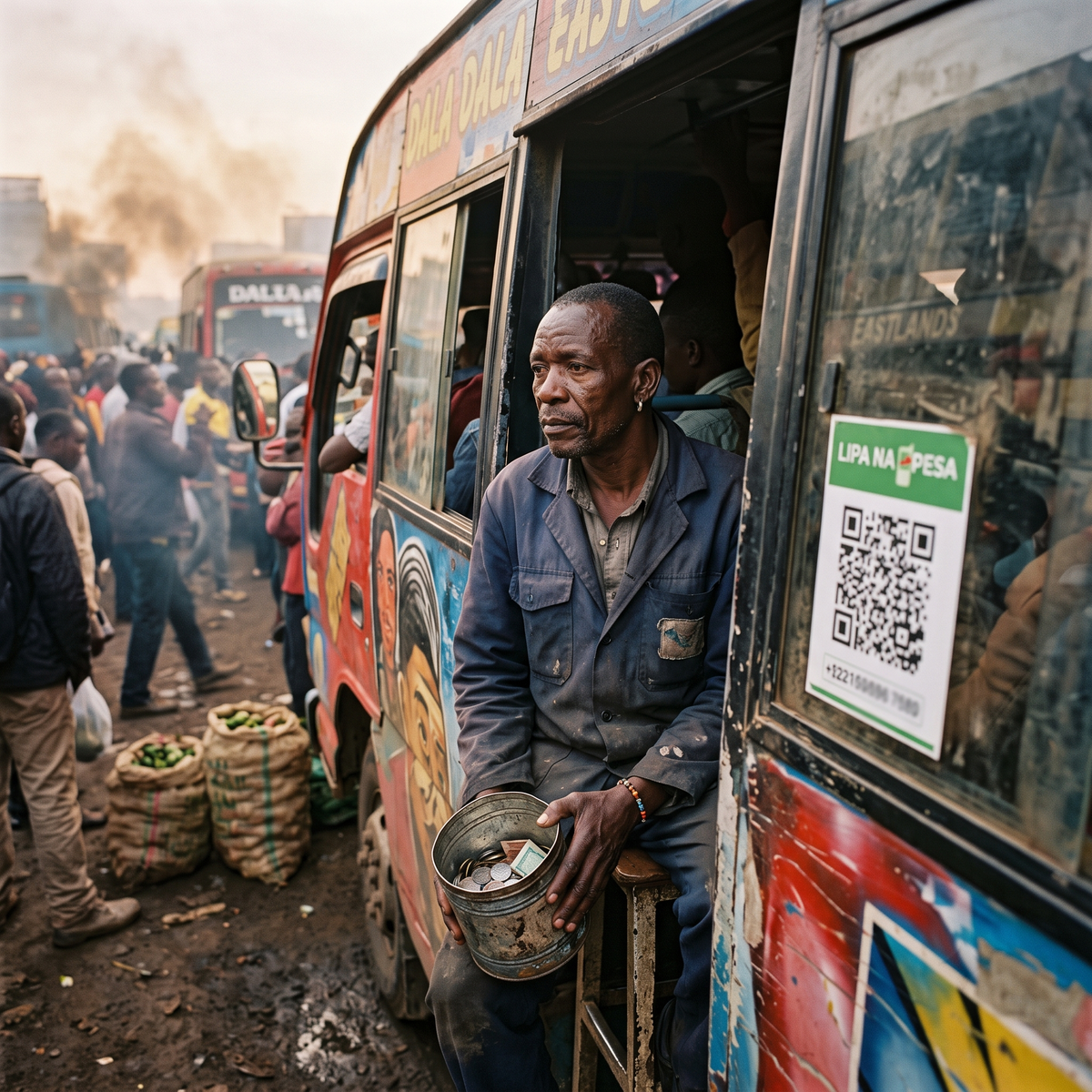
At the Eastlands stage [public transport pickup point], where the morning began with hoarse men shouting estates into diesel smoke, Wambua sat by the door of the matatu [shared minibus taxi] with his dented fare tin between his knees. The tin had survived two accidents, three drivers, one police crackdown, and a woman who once used it to hit a thief on the forehead. It was polished on the rim by years of fingers. When he shook it, coins answered like a small choir that had not eaten breakfast.
He had been a makanga [matatu conductor] long enough to know that fare was never just fare. Fare was rent postponed. Fare was a quarrel at home. Fare was a child being taken to clinic. Fare was a young man pretending he had forgotten his wallet because he wanted to buy chips for a girl in town. The driver only saw bodies entering and leaving. Wambua saw the small accounts people carried on their faces.
Mama Akinyi, who sold vegetables near the railway line, always paid with coins wrapped in a corner of her leso. If she sat quietly, her son in China had not called. If she complained about the price of tomatoes before saying hello, he had sent photos of snow again and she wanted somebody to marvel properly. There was a university boy with headphones who paid on Fridays and begged on Mondays. There was a fundi who smelled of paint thinner and carried screws in his shirt pocket. There was a woman who worked in a salon and never sat near the window because wind spoiled hair that had cost money. Wambua did not know all their names. He knew something more useful: where they alighted, when they were paid, and how much shame they could carry before a stranger noticed.
Then one Tuesday, Njeri arrived with a tablet, a blazer too serious for the heat, and a smile trained in boardrooms where nobody had ever chased a passenger from the back seat. She stood beside Chairman Githinji of the Sacco [transport cooperative], who had tucked his shirt into trousers that had given up arguing. “From next week,” she said, “this route will be fully cashless.” The conductors looked at her the way goats look at a new gate.
Njeri explained the system. A QR code would be stuck near the door. A till [mobile payment number] would receive money directly. Passengers would pay by M-Pesa [mobile money service]. The driver would see confirmation. The Sacco would see records. Leakage would reduce. Efficiency would improve. Transparency would become a word everyone had to respect. “What about us?” a conductor asked. “You remain very important,” Njeri said quickly. “You will guide passengers. You will ensure compliance. You will become customer-experience ambassadors.”
That one entered Wambua’s ear and sat there wearing shoes. Customer-experience ambassador. In twenty years he had been called makanga, boss, mzee [older man], thief, brother, mkubwa [big man], and once, during a Christmas rush, “my last hope.” Nobody had ever looked at him hanging from a matatu door and seen an ambassador.
The stickers came on Monday. Clean white squares on dusty glass. The driver read the till number aloud like a schoolboy reading an apology letter. Passengers lifted phones. The phones beeped. Money moved without touching anyone. At first, Wambua admired it. Even a man being replaced can respect neatness. No quarrelling over change. No coins rolling under seats. No passenger insisting he had given five hundred when everyone had seen one hundred. The young people paid with the bored confidence of people who had never balanced household peace on twenty shillings.
But by Thursday, the route had changed its music. The tin stayed quiet. Nobody negotiated loudly. Nobody said, “Boss, ongeza tu kidogo [just add a little].” The small theatre of fare collection closed early, and in its place came a beep, a screen, a nod. Wambua stood by the door with empty hands, smiling beside a sticker like a man hired to guard a framed certificate.
Mama Akinyi was the first to trouble the system. She entered at Jogoo Road with two sacks of sukuma wiki and a phone whose battery had died somewhere between yesterday and hope. “Wambua, leo utanisaidia [today you will help me],” she said. “I will send when I reach the kibanda.” Before, this was not even a story. Wambua would knock the tin with his knuckles, make a face, and write her debt in the part of his brain reserved for women who always paid. But Njeri was doing a rollout check that morning, tablet in hand.
“Every passenger must complete payment before travel,” she said, gently enough to sound cruel by accident. “This is Mama Akinyi,” Wambua said. Njeri looked at the woman, then at the tablet. “The system does not have Mama Akinyi.” “Then the system is still young,” Wambua said.
A few passengers laughed. Njeri did not. She opened her mouth to explain policy, but the driver, who feared delay more than policy, started the engine. Wambua waved Mama Akinyi in and spent the whole trip feeling the old world and the new one sitting beside each other, refusing to greet.
That evening he bought a small exercise book from a kiosk. On the cover was a cartoon lion looking more confident than any lion in Nairobi has a right to look. He wrote Mama Akinyi — 80. Under it he wrote Monday boy — 50. Then Salon window woman — paid, but cried. Then Fundi — 30 balance, paint on sleeve. He told himself it was for reconciliation. A good English word can make foolishness wear a tie.
Within two weeks, Wambua’s book knew the route better than the dashboard did. It knew who paid digitally but still needed three days before being asked about arrears. It knew which passenger sent fare from a wife’s phone and which one used the name “Brian” though everyone called him Kaka. It knew the stops where kanjo [city enforcement officers] liked to appear and the estates where rain turned the road into porridge. Passengers began to relax around the book. “Mzee, umeandika? [Old man, have you written it?]” they would ask when life caught them before payday. Wambua would tap his shirt pocket. He did not abuse the trust. He was firm where firmness was needed. He was not a charity. He was an archive with a whistle.
Njeri noticed the book during a Friday inspection. She asked for it with the polite hand of somebody requesting evidence. Wambua hesitated, then gave it to her. She turned the pages slowly. Numbers first. Then names. Then notes. Not proper notes, not the kind a company could put in a spreadsheet without feeling ashamed. Mama Akinyi — son called. Monday boy — exam week. Salon woman — do not ask loudly. Fundi — wife in hospital. There were arrows, ticks, tiny marks only Wambua understood.
“This is not official,” Njeri said. “Neither are people,” Wambua said. “But they keep entering the vehicle.” She almost smiled. That was the danger with Njeri: she was not a villain. Villains are easy; you can see them coming because they enter with thunder. Njeri entered with a charger, a policy document, and the tired face of a young woman whose own bosses called her at night using words like deliverables.
“The Sacco wants clean data,” she said. “I have data.” “You have stories.” Wambua took back the book. “Stories are data that removed their shoes.”
Chairman Githinji summoned him the following Wednesday. The Sacco office was above a hardware shop and smelled of dust, tea leaves, and ambition that had been stored too long. On the wall was a calendar from a bank, still showing March because nobody had wanted to climb on a chair and move the page. Githinji did not begin with bad news. Men like him never did. They first praised your loyalty so that by the time they reached the knife, you were expected to admire the handle.
“You have served this route,” he said. “People respect you. Even complaints about you are respectful.” Wambua sat with his tin on his lap. He had brought it because a man carries his office when he suspects the building is being taken.
“The cashless system is performing,” Githinji continued. “Collections are up. Leakage is down. Owners are happy. But there is something we have discovered.” Wambua waited. “We need customer intelligence.” The phrase arrived wearing Njeri’s shoes.
Githinji leaned forward. “These things you know — regular passengers, stops, payment behaviour, peak times, small debts — they can help us design products. Weekly passes. Loyalty fares. Targeted messages. You understand?” Wambua understood too well. They had removed the coins from his hand, then returned to ask for the fingerprints.
“You want my book,” he said. “Not your book exactly. The information. We can give you something small for your contribution.” “And my work?” Githinji sighed, not because he was sad, but because sadness was useful in rooms where salaries were being reduced. “The role is changing. We cannot keep everyone. The driver can monitor payments. The system sends reports. You can maybe train the younger attendants for a short period.”
For the first time that morning, the office became properly quiet. Outside, a matatu coughed awake. Downstairs, somebody dropped metal rods, and the sound climbed the stairs like coins falling through a larger tin. Wambua looked at Njeri, who had been sitting near the window, tablet asleep on her lap. She did not look proud. She looked like a person watching a bridge being built with timber from someone’s house.
He opened the exercise book. For a moment, he saw the whole route there: Mama Akinyi’s snow, the salon woman’s tears, the student’s Monday hunger, the fundi’s hospital balance, the driver’s impatience, his own handwriting leaning forward as if running after the bus. Then he tore out the pages with amounts and handed them to Githinji. He left the pages with the stories inside the cover.
“Your clean data,” he said. Githinji frowned. “And the rest?” “The rest did not pay fare.”
By the end of the month, Wambua was no longer on the door. A younger man stood there now, pointing at the QR code with the enthusiasm of someone who had not yet learned how quickly a job can become a sticker. The route continued. Of course it did. Nairobi does not pause to check whether a man has been removed from its noise.
Mama Akinyi found him one evening near the stage, holding vegetables and looking offended on his behalf. “Who will remind me to call my son now?” she asked. Wambua laughed because if he did not laugh, he would have to explain a sadness too small for newspapers and too large for his chest. “Your phone has reminders.” “My phone does not ask with respect.”
He walked home with his fare tin under his arm. At the house, he placed it on the shelf above the radio. For years the tin had returned full of other people’s movement: coins warm from palms, notes folded with excuses, the dust of routes, the smell of pockets. Now it held one forgotten coin and the last torn edge of the exercise book cover.
Outside, buses coughed in the dark, leaving the stage, collecting beeps. Wambua touched the tin once. The coin inside turned slowly, making a thin, stubborn sound, as if somewhere in all that new silence, somebody had finally issued him a receipt.
衣装を通販で探すときは、商品画像だけでなく実寸とセット内容も確認しておくと安心です。条件に合う選択肢を探す際は、ポリス コスプレ 衣装 レディースを手掛かりに内容を確認できます。商品が届いたら付属品とサイズを早めに確認し、必要な調整を本番前に済ませましょう。
Jaba Man
Jaba Man · Kenyan writer. Fiction and true stories from everyday Nairobi.