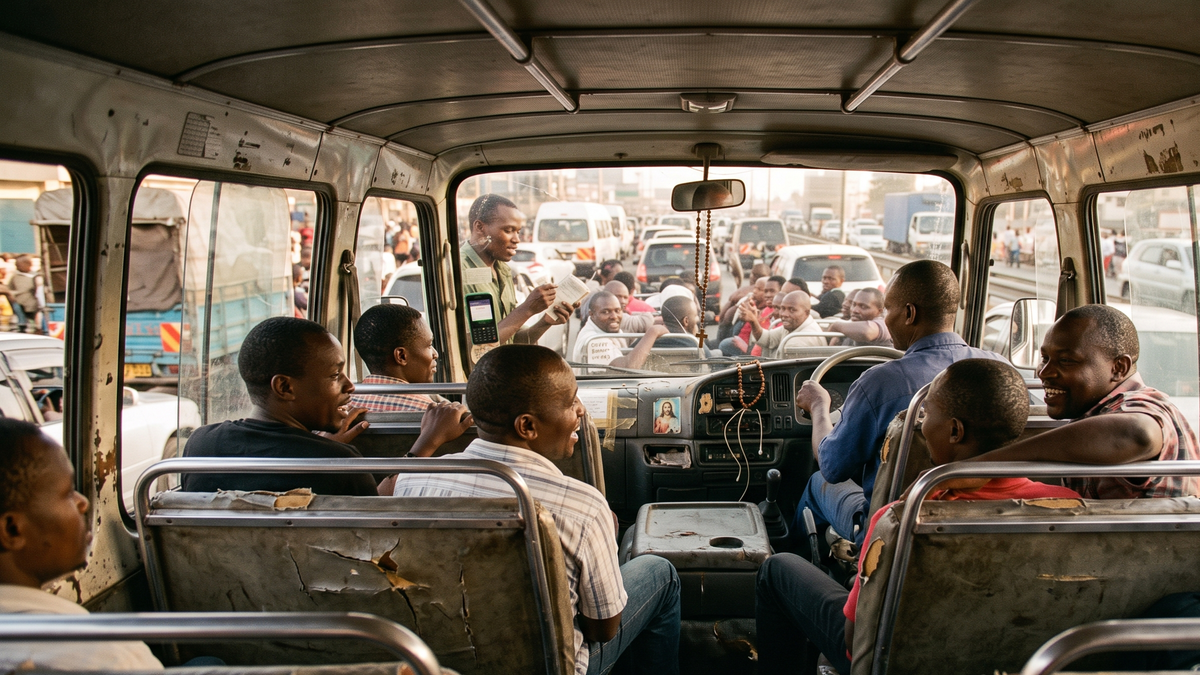
The Blessing Executive Shareholders
When an aging Thika Road matatu needs brake repairs before inspection, its passengers contribute money—and immediately become noisy shareholders in the vehicle that carries them.
The Blessing Executive did not drive so much as negotiate with the road.
Every morning on Thika Road, it left Githurai with the confidence of a man wearing a borrowed suit to a wedding. It rattled, coughed, gathered itself, then joined traffic with the weary dignity of something that had refused to die for too long to start dying now. Its blue paint had faded into the colour of old chewing gum. The seats were cracked where elbows had lived. Above the driver’s head, a small sticker of Jesus had curled at the edges until the Son of God looked as if he, too, was tired of the heat.
Musa drove it with both hands and a private apology. He was not an old man, but the road had started writing old-man things on him: the squint of someone who expected foolishness, the neck of someone who slept badly, the silence of someone who knew the price of every small repair before the mechanic opened his mouth. Fifteen years behind a steering wheel had given him a gift for judging people by how they entered a matatu [shared minibus taxi]. People who entered backwards looking for change were trouble. People who asked, “Utafika town?” [will you reach town?] when the vehicle was clearly going to town were philosophers. People who said “I will pay with M-Pesa” before sitting down had no money.
The vehicle was called Blessing Executive, though nobody could explain which part was the blessing and which part was the executive. On the windscreen, in old white cursive, another name floated like a ghost: Sheila. Sheila had belonged to a previous driver’s love life. The love had ended. The lettering had remained. Nairobi is full of men carrying names of women who no longer pick their calls.
On Friday afternoon, the Sacco [transport cooperative] sent a message that made Musa sit very still. The inspection certificate would expire on Monday. No new sticker, no route. No route, no day’s collection. No day’s collection, no landlord, no school fees, no small packet of unga [maize flour] carried home with the quiet shame of a man who wished it were bigger. The problem was the brakes.
They had been speaking for weeks. Not loudly, not yet. Just small complaints when Musa slowed near Garden Estate, a tired groan as the vehicle joined the service lane, a metallic sigh that made him turn down the music and listen like a father listening to a child cough at night. He had promised himself he would fix them after rent. Then after the tyre. Then after the loan app stopped sending messages that began with Dear Esteemed Customer and ended like a curse.
Kago, his tout [matatu conductor], read the Sacco message over Musa’s shoulder and whistled.
“We do a harambee,” he said. Musa looked at him slowly. “For brakes?”
“For life,” Kago said, because Kago had never met a small issue he could not dress in a suit and send to Parliament. “We tell them the truth. This is their car. They enter every day. They sleep here. They quarrel here. Some even eat boiled eggs here and leave the shells. If they love the Blessing, let them show love.”
A harambee [community fundraiser] was not strange in Kenya. People raised money for funerals, hospital bills, school fees, weddings, church roofs, political dreams, and occasionally for things that had no name but had already eaten money. But Musa had never heard of passengers raising money for a brake system. He imagined standing at the door, hat in hand, asking people who already complained about fare to contribute to the thing that carried them. The thought entered his chest and sat there like a stone.
“I am not begging passengers,” he said. Kago looked wounded. “Who said begging? This is stakeholder engagement.” By Saturday morning, stakeholder engagement had begun.
Kago did not ask. He launched. At the stage, with one foot on the step and one hand slapping the roof, he addressed the first passengers like a man unveiling a national budget. “My people, my shareholders, members of the Blessing Executive family. Our vehicle has a small health challenge. The brakes are coughing. Monday there is inspection. If we don’t repair, we all become pedestrians. If you love comfort, if you love arriving alive, support this noble cause.”
People looked up from their phones with the suspicious expression Kenyans reserve for new charges. A man in a checked shirt asked if the fare had not already included arriving alive. A woman near the window laughed without opening her mouth. Someone at the back said, “Hiyo ni mambo yenu” [that is your issue], but he said it softly, because the vehicle was already moving and the brakes had just made a sound that supported Kago’s case. Mama Brian was the first to put money in.
She was not Brian’s mother in any official document inside the matatu, but after three years on that route she had become everybody’s Mama Brian. She boarded at the same spot, carried exact change folded inside a handkerchief, and corrected young men who put dusty shoes on the seat rail. She had the authority of a school deputy principal and the handbag of a woman prepared for both church and war.
“I will give five hundred,” she said. Kago’s face opened like a shop at sunrise. “Mama, may you never lack.”
“But,” she said.
The whole matatu understood the but. Money in Kenya rarely travels alone. It arrives with relatives.
“If we are contributing, we need order. First, that music. Every morning, noise. Boom boom boom. Some of us are going to look for bread, not to a disco. From five to nine, gospel only.”
A young man in a tie that had lost hope protested. “But some gospel also has boom boom.”
“Then soft gospel,” Mama Brian said. “Something that remembers God is not deaf.”
Kago nodded as if minutes were being taken. “Soft gospel. Five to nine. Approved.”
That was the first mistake. The moment passengers saw that conditions could be approved, the Blessing Executive stopped being a matatu and became a committee.
The young man in the tired tie contributed two hundred and pointed at the windscreen. “Also remove Sheila. Who is Sheila? Every day I am entering another man’s heartbreak. It is not professional.”
“Sheila has never disturbed anyone,” Musa said.
“She disturbs branding,” Kago said quickly, because he could already see another two hundred shillings forming. “We shall rebrand.”
A student with a laptop bag and the smooth confidence of someone who had not yet met HELB [Higher Education Loans Board] repayment messages gave three hundred and requested Wi-Fi.
“For what?” Kago asked.
“For traffic. For productivity.”
“Brother, we are repairing brakes.”
“Exactly,” the student said. “If we are modernizing, let us modernize properly.”
By midday, the money sat in a biscuit tin under Kago’s feet, wrapped in notes and opinions. Every coin made the vehicle louder. People who had never greeted Musa now wanted procurement transparency. A man near the front asked whether there would be a receipt. Mama Brian demanded a WhatsApp group. The checked-shirt man suggested a new route slogan: We Brake for You. Someone else said that sounded like a funeral announcement.
Musa drove through all this with his jaw tight. Gratitude is a strange thing when it comes wearing muddy shoes. He was thankful, yes. He was also exposed. Each contribution lifted him a little and undressed him a little. It told the whole vehicle that the man who carried them to work could not carry his own brakes.
On Sunday afternoon they took the Blessing Executive to a dusty garage near Githurai where men in overalls moved slowly around wounded vehicles, calling each other boss while charging each other like enemies. The fundi [mechanic] did not waste words. He crouched, looked, touched, spat to the side, and named a figure that made Musa close his eyes. Kago opened the biscuit tin with ceremony. The mechanic counted the money, then looked at the vehicle. “Who contributed?”
“Passengers,” Kago said proudly.
The mechanic laughed once. “Then repair properly. Passengers complain more than owners.”
Musa stayed until the old parts came out black and ashamed. He watched new pads go in. He asked for a receipt, then asked for another one because the first had grease across the amount. Kago took a photo of everything. Mama Brian had already sent three messages: Have they started? Are you supervising? Don’t let those garage people cheat you. The student asked whether the Wi-Fi router had been budgeted for under miscellaneous.
By Monday morning, the Blessing Executive sat in the inspection queue cleaner than it had been in months. Kago had wiped the dashboard. Sheila was still on the windscreen because removing love, even old love, required money they had decided to spend on brakes. The Jesus sticker had been pressed flat with clear tape. Behind it, Musa had tucked the garage receipt like a small secret.
The queue moved pole pole [slowly/gently]. Drivers stood outside their vehicles pretending not to worry. Conductors compared rumours. Somewhere ahead, a horn cried and died. Musa sat with both hands resting on the steering wheel, listening to the new silence under the vehicle. It was not complete silence; no matatu is ever silent. But the old groan had gone. In its place was a pause, and inside that pause Musa felt something unclench.
When their turn came, the inspector climbed in with a clipboard and the face of a man who had seen every prayer sticker in Nairobi. He checked the lights, the belts, the tyres, the triangles. He pressed the brake pedal. Once. Twice. He looked at Musa, then at the dashboard.
“This one has been repaired,” he said. Musa did not smile. Not yet. Hope can embarrass a grown man in public.
The inspector signed, stamped, and placed the new sticker on the windscreen, close to Sheila, below a corner of morning sun. Kago exhaled so loudly a driver in the next lane turned to look.
On the first trip back, the shareholders were waiting as if they had personally negotiated with the government. Mama Brian boarded and inspected the sticker before sitting. The student asked whether phase two could now begin. The man with the tie said Sheila’s days were numbered. Kago announced that all suggestions should come through official channels, by which he meant him. Then Musa braked near the service lane.
Nothing screamed. Nothing sighed. The Blessing Executive slowed with a firmness so ordinary it silenced them. For three seconds, nobody made a joke. Not even Kago. The passengers felt, in their knees and shoulders, the small boring miracle their money had bought. Not Wi-Fi. Not a new name. Not soft gospel. Just the ability to stop when stopping was required.
Mama Brian cleared her throat. “Play the gospel,” she said, but softly now, without a motion to adopt. Kago lowered the volume before anyone asked.
初めて衣装を用意する際は、必要な付属品と別途準備するものを先に整理すると進めやすくなります。サイズやセット内容を確認する場合は、天使 コスプレ 衣装 通販から候補を探せます。注文前に使用日と発送予定を照らし合わせ、試着や調整に使える時間も確保しておくと安心です。
Musa guided the matatu back into Thika Road, where traffic shone and coughed under the morning light. The new sticker trembled on the glass. Behind the taped Jesus, the repair receipt trembled too, a small oily paper holding the names of brake pads, labour, and the day a noisy committee accidentally saved its own ride.
Antes de comparar modelos, merece la pena precisar la opción entre camiseta local, visitante o alternativa. Antes de descartar un modelo, merece la pena confirmar la temporada y el diseño descritos. La información reunida en «» ayuda a comparar los resultados que mejor responden al objetivo planteado. Antes de elegir definitivamente, conviene revisar las medidas utilizadas para determinar la talla.
Jaba Man
Jaba Man · Kenyan writer. Fiction and true stories from everyday Nairobi.