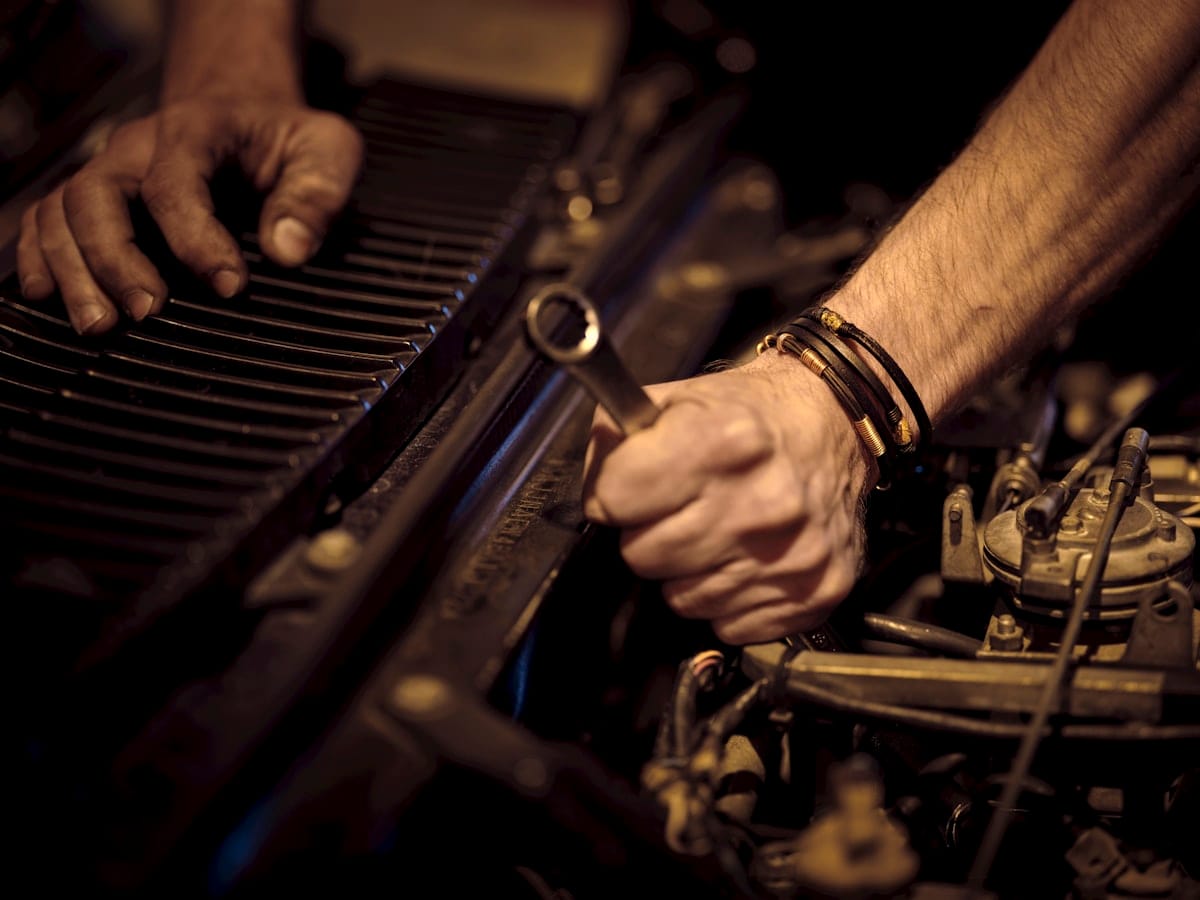
Mzee Jamo's garage
Most mechanics dismantle your car so you can't leave. Mzee Jamo doesn't do that.
I'm sitting in a plastic chair in a garage in Ngong. The air smells of old oil and burnt rubber. A radio plays some old Rhumba from a small silver box perched precariously on a stack of tyres. There is a dog sleeping in the shade of a dusty Toyota Premio.
I'm waiting for my mechanic. I call him Mzee Jamo. He's old. He has a forehead that looks like a map of the Rift Valley. He's the kind of guy who can listen to your engine and tell you what's wrong without opening the bonnet. He has a toothpick stuck in the corner of his mouth. He's currently under a Prado, his legs sticking out like he's been swallowed by the car.
"Sawa, just wait a bit," he told me when I arrived. "I'm finishing something here."
I sit. I watch him. I watch his kurutu, a skinny boy called Otieno who looks like he's never eaten a full meal in his life. Otieno is handing him tools. A 10mm spanner. A torch. A rag. Otieno is fast. He's like a pit crew of one. He's also the one who will eventually do the dirty work.
I've been to many garages in my life. I've seen the strategy. You go to a garage and tell the mechanic your car is making a weird sound. He says, "Sawa, let me see." He's busy, of course. He's always busy. He's always under someone's car. He calls his kurutu. The kurutu starts unscrewing things. You don't know what he's unscrewing. You don't know if he's unscrewing the problem or the radio.
Then you realise that your car is now in pieces. The engine is open. Parts are scattered on the floor. You can't drive away. You are now a hostage. You are his prisoner. You are now at the mercy of his timeline. He will take his time. He will go for lunch. He will go for tea. He will take a nap. He will talk to other clients. He will tell you, "It's a complicated job, boss." And you will wait. Because you have no choice.
Mzee Jamo doesn't do that.
He slides out from under the Prado. He wipes his hands with a rag that looks like it was used to clean a chimney. He walks over to my car and stands there for a minute, staring at it. He doesn't touch it. He just stares at it like he's trying to intimidate it into submission.
"What's the problem?" he asks.
"It's making a sound," I say. "Like something is loose."
He gets in. He starts the engine. He listens. He turns it off. He gets out. He looks at Otieno.
"Otieno, bring the car inside," he says.
Otieno jumps in and drives it into the pit. Mzee Jamo disappears under it. I hear him grunting. I hear the sound of something metallic hitting something else. I hear him say something in Kikuyu. I don't know what he said, but it sounded like he was talking to the car, not Otieno.
"It's the suspension," he says, emerging from under the car. "I can fix it in ten minutes."
He doesn't dismantle my car. He doesn't call for a meeting. He doesn't ask for a deposit. He just tells Otieno to get the tools and they get to work.
"You know," I say, "most mechanics dismantle your car so you can't leave."
He laughs. It's a dry laugh. Like someone rubbing two pieces of sandpaper together.
"That's because they don't trust you," he says.
"Trust me with what?"
"That you will pay."
"I always pay."
"I know. That's why I'm not dismantling your car."
I like that. I like the idea that he trusts me. I like that he doesn't feel the need to hold my car hostage. It's a small thing, but it's also a big thing. It's the difference between a transaction and a relationship.
Otieno hands him a wrench. He's fast. He's efficient. He's like a well-oiled machine. He doesn't talk much. He just does what he's told.
"How long have you been working for him?" I ask him.
"Two years," he says.
"Do you like it?"
"I like cars," he says.
"Do you like Mzee Jamo?"
He looks at Jamo, who is now tightening a bolt. Jamo looks up and grins.
"He's okay," Otieno says. "He doesn't beat me."
I laugh. "He beats you?"
"Sometimes he shouts," he says. "But he's a good teacher."
Jamo stands up and wipes his hands. "Sawa. Try it now."
I get in. I drive out of the garage. The sound is gone. The car feels tight. I drive to the main road and merge into the traffic. I think about how lucky I am to have a mechanic who doesn't dismantle my car.
I think about all the mechanics out there who do. I wonder if they're lonely. I wonder if they go home and tell their wives, "Today I held three cars hostage."
I wonder if they dream of cars that they can't dismantle.
I drive off. The sun is getting hotter. I'm thinking about lunch. I'm thinking about how nice it is to be trusted.
I think we all want to be trusted. To be told, "Sawa, I will fix this, you can go, I will call you when it's ready." To be given the benefit of the doubt. To be seen as someone who keeps their word.
It's a small thing, but it's also a big thing. It's the difference between a transaction and a relationship.
And it's why I will always go back to Mzee Jamo. Not because he's the best mechanic in Ngong, but because he trusts me.
Para reducir opciones desde el principio, es útil establecer la prioridad entre colección, uso habitual y exposición. Para interpretar correctamente la información, conviene comparar la longitud, el ancho y la medida del pecho. Una consulta como «» permite comparar las opciones disponibles con criterios claros. Para evitar sorpresas, conviene revisar las instrucciones de lavado y conservación.
And because he doesn't beat Otieno. Much.
As an event approaches, it is worth considering how details related to game cosplay costumes will affect the complete look. When comparing costume options, a comparison of details related to men's cosplay costumes can clarify differences in colour and construction. To organise preparations involving details related to cosplay shoes, women's cosplay costumes with matching accessories can help narrow the options for a specific purpose. Before the preparation is complete, a balanced view of details related to wig colour selection can support both detail and comfort.
Jaba Man
Jaba Man · Kenyan writer. Fiction and true stories from everyday Nairobi.