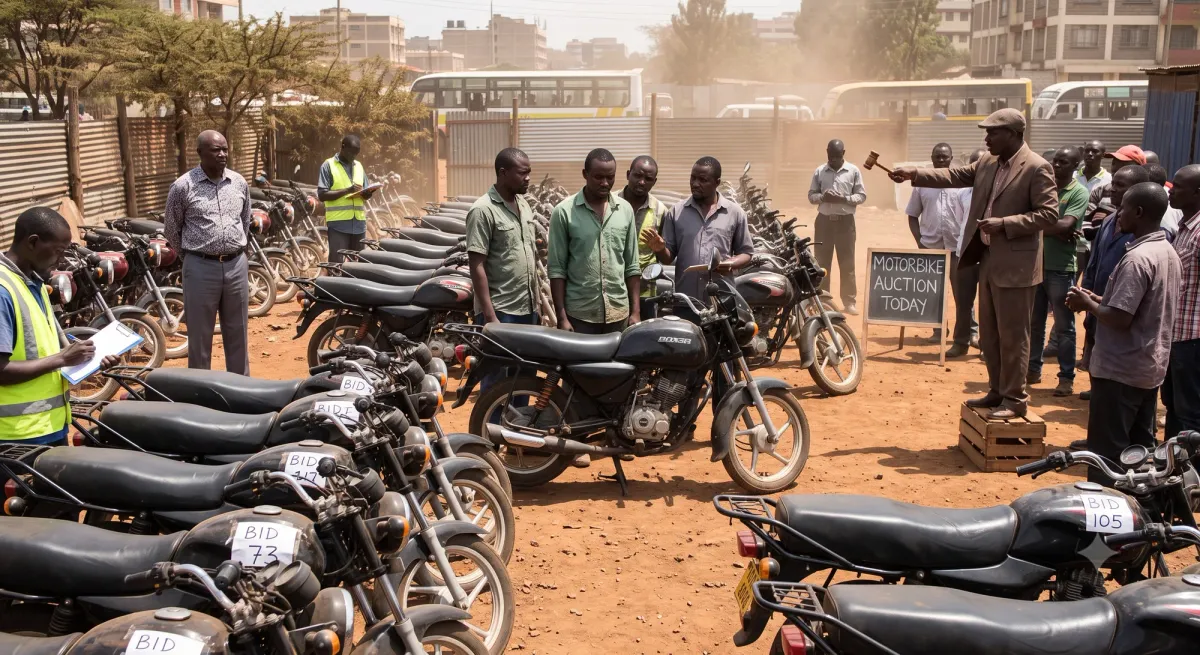
Auction Day for the Repossessed Boda
A proud boda rider tries to buy back his repossessed bike at auction, but the real debt is the story he made everyone carry for him.
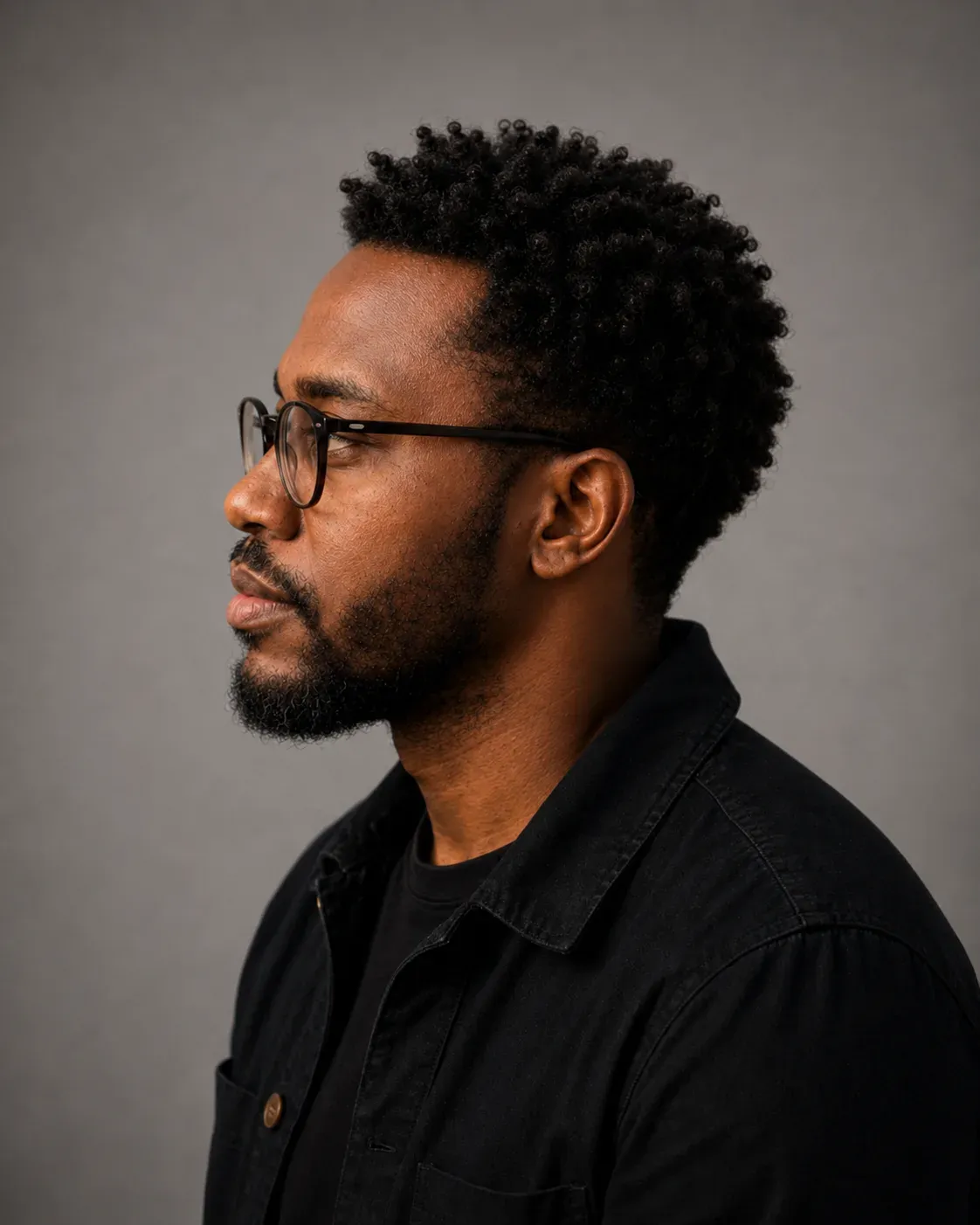
At a boda stage, a helmet is not just a helmet.
It is a crown when the morning is young and the first customer has not yet decided whether to trust you. It is a bowl when rain starts and nobody is moving. It is a drum when a rider taps it against the fuel tank to announce that he is still here, still waiting, still somebody.
For Muriithi, the black helmet with the cracked visor had become all three. He wore it even when he was not riding, because a man without his machine can still confuse people from a distance if he keeps the helmet on.
The machine itself was gone.
Not stolen. That would have been easier to explain. Stolen gives you a villain. Stolen allows people to click their tongues and say Nairobi has become bad. This one had been taken politely by two men in office shoes who arrived at the stage with papers, asked for him by name, and called him "sir" three times while removing the only thing that made him sir to anyone.
The other riders pretended not to watch. That is the cruelty of men at a stage; they will laugh loudly at your jokes for six months, then study their phones with great seriousness when your life is being folded into a clipboard.
"Ni mambo ya loan?" one of them asked later, when the men had gone.
Muriithi said, "Small confusion."
Small confusion is what Kenyans call a fire when it has reached the curtains.
The bike had been bought on loan, of course. Everything that shines in this country belongs partly to someone in an office you have never seen. Muriithi had signed the forms with a thumb that still smelled of engine oil. The salesman had said, "This one pays for itself." A sentence like that should be illegal. It enters a poor man's ear wearing perfume.
For a while, it was true. The bike paid. Nakuru mornings, Nairobi trips, airport bags, market women, drunk men, girls going to college, office people who wanted to beat rain. The phone kept beeping. M-Pesa confirmations came with that small music of survival. Muriithi began to stand differently at the stage, one hand on the handlebar, one foot on the peg, as if the road had personally invited him.
Then the rain came, and after the rain came a matatu at the wrong angle, and after the matatu came two weeks of limping around his room while the bike leaned in a mechanic's shade looking ashamed of both of them.
The loan did not limp. The loan continued walking.
By the time the papers arrived, Muriithi had already used parts of other futures to patch the present. He had borrowed from the chama. He had delayed the mechanic. He had told Faith, his fiancée, that one more good month would clear the bad air. He had told Faith's father that the wedding balance was safe. He had even paid the bride-price deposit with money that had passed through the bike loan so quickly it had left fingerprints on both families.
This is how debt works. It does not remain in the account where you put it. It enters conversations. It sits at family meetings. It smiles in engagement photos. It lets people call you responsible until the day it removes the chair.
A week after the repossession, Muriithi found the bike listed for auction. The starting price was lower than what he still owed.
He stared at the screen in a cyber café where the keyboard had three missing letters and the young man at the counter was eating smokie with the concentration of a surgeon.
"Boss, print?" the young man asked.
Muriithi said, "Print."
He folded the paper and placed it inside the helmet.
The chama met that evening in the back room of a wines-and-spirits in Buruburu. They called themselves Pillars of Strength, a name chosen in January when everybody had hope and nobody had yet asked for an emergency loan. Six riders sat on plastic chairs around a table scarred by bottle rings. Otieno the treasurer opened his ledger with the sadness of a priest opening a book of sins.
"I need help," Muriithi said.
Nobody spoke. Outside, someone laughed at the counter. A fridge hummed. A phone beeped, and every man in the room glanced at it as if money had called his name.
"They are auctioning my bike on Tuesday. If we move fast, we can buy it back. I have twenty thousand. I only need the group to stand with me."
"Stand with you how much?" Otieno asked.
There are questions that remove your shirt in public.
"Forty," Muriithi said.
"Forty thousand?"
"To be safe."
Otieno looked at the ledger, then at Muriithi, then at the helmet on the table. "You still owe the group twelve."
"I know."
"You also told us last month that the bike was bringing money."
"It was."
"Where did the money go?"
A smaller man would have lied quickly. Muriithi delayed, which is the luxury liars think makes them look honest.
"Things came up."
"Which things?"
The helmet sat between them, cracked visor facing the ceiling, waiting to become a bowl.
On Tuesday, the auction yard smelled of dust, hot metal, and men's calculations. Rows of repossessed motorbikes stood under the sun with bidder numbers tied to their handlebars. Without riders, bikes look embarrassed. They are machines built for leaning, shouting, squeezing through traffic, carrying sacks of potatoes and schoolchildren and somebody's auntie with a live chicken. Parked in rows, they look like evidence.
Muriithi's bike was number 42.
It looked smaller than he remembered.
The Pillars of Strength came with him, though not all with money. Some men come to help you with presence, which is useful only if shame accepts witnesses as payment. Otieno came with the ledger. Wambugu came with advice. Kariuki came with silence. Silence was the most generous contribution.
Then Faith arrived.
She was not supposed to know. Not yet. Muriithi had planned to tell her after the rescue, when the bike was back, when the story could be shaped into something heroic. But Faith came walking through the yard in flat shoes and a blue sweater, her father beside her, his hands behind his back like a man inspecting a school where fees had not been paid.
Muriithi felt the day tilt.
"You said the bike was at the garage," Faith said.
"It was."
"Now the garage has bidder numbers?"
Her father did not greet him. Some fathers are not rude; they are simply economical with respect.
The auctioneer climbed onto a small platform and began reading numbers. His voice had the cheerfulness of a man selling other people's panic by the kilogram. Bids rose. Phones beeped. Men lifted fingers, then lowered them when courage remembered rent.
When number 42 was called, Muriithi stepped forward.
The bidding began at fifteen thousand.
A man in a faded blue shirt raised it to sixteen. Another man said seventeen. Muriithi said eighteen too loudly. The auctioneer smiled. He had heard desperation before; it always came with a cracked voice.
"Twenty," Muriithi said.
Otieno shifted beside him.
"Twenty-two," said the man in blue.
Faith looked at Muriithi, not angrily. Anger would have been easier. She looked as if she was watching a chair break slowly under somebody she loved.
Muriithi touched the helmet under his arm. Inside it were folded bidder papers, a small envelope of cash, and the sticker Faith had once placed inside the visor because she said every rider needed something soft near his head. The sticker was peeling now. Her smile had a line through it where the visor had cracked.
"Twenty-five," Muriithi said.
The man in blue looked at the bike, looked at Muriithi, then looked at Faith's father. That look was a small village meeting. He stepped back.
"Sold," the auctioneer said.
People clapped the way people clap at auctions, not with joy, but to close a wound quickly.
Muriithi had bought back his own machine with money that made everyone poorer.
That evening, the chama met again in the back room. The helmet went around the table, not as a crown now but as an offering bowl. Coins dropped in. Notes folded twice. Promises entered with no shoes. Otieno wrote everything down.
Faith sat beside Muriithi. Her father sat across from him, saying nothing. That silence did more work than anger.
"We are a chama," Otieno said finally. "Not a miracle."
Nobody laughed.
Muriithi looked at the helmet moving from hand to hand and understood, slowly, that the bike had not only carried passengers. It had carried his version of himself. Hardworking man. Future husband. Son-in-law with a plan. Rider with his own machine. A man can balance many things on two wheels until the road asks for proof.
"I lied," he said.
The room became very still.
"Not one big lie. Small ones. The type that look like arrangements. I told Faith the bike was enough. I told Mzee the wedding money was coming. I told the chama I only needed time. I told myself the road would fix what the road had broken."
Faith looked down at her hands.
"So what now?" her father asked.
It was the first question he had asked all day. Not accusation. Not forgiveness. A door, opened one inch.
Muriithi removed the bidder papers from the helmet and placed them on the table.
"Now I pay people in the order I hurt them," he said. "The wedding waits. The bike works. The chama is paid first. Faith decides whether she is tired. You decide whether I am still a man you can talk to."
That last sentence cost him more than twenty-five thousand.
Outside, the bike waited by the curb, dusty, reclaimed, not forgiven. A boda is like that. It can return to you and still refuse to make you innocent.
Later, when the meeting broke, Muriithi carried the helmet to the passenger seat and placed the folded bidder papers inside it. Faith stood beside him in the doorway. For a while neither of them spoke. Nairobi moved around them: bottles clinking, a matatu coughing, someone laughing too loudly at the front of the shop, phones beeping with other people's money.
Faith touched the cracked visor.
"You should have told me," she said.
"I know."
"Not because I would have saved you. Because I was already inside the thing you were hiding."
There are sentences that arrive quietly and park forever.
El proceso resulta más práctico cuando se define el contexto de uso, como estadio, entrenamiento o tiempo libre. Para reducir errores, es importante verificar si la talla sigue el mismo criterio que otras prendas consultadas. Al consultar «», resulta más sencillo comprobar si los resultados responden al objetivo planteado. Como verificación previa, es útil leer las condiciones de cambio y devolución.
Muriithi nodded. He wanted to promise. Men like him always want to promise at the exact moment when promises have become cheap. So he did not. He only stood there with the helmet between them, full of papers, no longer a crown, not yet a bowl, just a small tired head holding the evidence of what it had cost to become honest.
When choosing a first cosplay outfit, it is worth considering how details related to cosplay props will affect the complete look. When the final look will be photographed, it helps to assess details related to long cosplay wigs together with fit and fabric. To organise preparations involving details related to character accuracy, cosplay wigs for Halloween can help narrow the options for a specific purpose. To stay comfortable throughout the event, it is useful to check details related to shoes and accessories against the wearer's own needs.
Jaba Man
Jaba Man · Kenyan writer. Fiction and true stories from everyday Nairobi.